Flip Through

Showing posts with label Feminism. Show all posts

Saturday, November 30, 2013

Mormon Women Bare

Hi! It's been a thousand years since I've emblogginated!

But look. What an interesting project. I am particularly intrigued by this statement from the FAQ:

What we are exploring is how a woman views herself and her body after spending the majority of her life, particularly her formative years, in the Church.
As a teenager in the LDS church often enough I found few similarities between myself and the other girls in my cohort, even my closest friends; looking back now, it's a bit easier to feel compassion for the younger woman I was, as well as for my friends, who almost certainly were dealing with the same doubts and fears as I was. We all had the same upbringing, after all. 

I wouldn't say that I am comfortable with my body. Certainly I am not properly appreciative of its health, its strength. It rarely gets bogged down with colds, and it's capable of walking two miles in work shoes. It can chop onions without crying, make love while laughing, dance with only twinges of embarrassment--but what I see in the mirror is a weird nose and flab and knobby knees. How much of that is from soaking in US beauty culture for twenty-six years, and how much of it is leftover confusion and assumptions from various lessons learned in fifteen years of LDS culture? 

"My body is capable of producing children, therefore it should, and since it hasn't, I am not a Real Woman (TM)." No, no, the choice is mine. Really. It is. Really.

"The way that my body is maintained is not attractive to some men, and I should probably change that." No, no, I was not born onto the earth to be attractive to men. Really. Really.

Run-of-the-mill Western kyriarchy dosed with dogma backing up the immutability of sex and the eternal significance of gender roles; a culture that--overtly or covertly, intentionally or accidentally--promotes a certain body and code of attractiveness for female members. I have a new litany now, one I'm conscious of, one that reminds me of all the ways I have found joy in my body. May we continue to rebuild ourselves.

Thursday, July 25, 2013

Copilots

In case you hadn't heard, Pacific Rim is basically the greatest action film ever made. There's nothing I can say about it that hasn't already been said, so have a few on the topic that I've particularly enjoyed:

  1. Pacific Rim, Raleigh, and Emotional Intelligence
  2. Is Mako Mori a Feminist Hero?
  3. my bud Nathan's review
  4. Simple Does Not Equal Dumb
  5. Beyond the Smashing
  6. in case you needed convincing
  7. Still not convinced?
(Mako will wait while you go buy your tickets)

Monday, July 15, 2013

The dynamic advantage of beauty (Tampa spoilers)

I felt like [the title] nicely represented the dualism of her character. With the text being so overtly sexual and boisterous on the inside, it seemed appropriate to title the book something ambiguously general—it mirrors the way Celeste represents herself as a harmless beauty with mass-appeal when she’s actually a complete monster. Alissa Nutting talks to Roxane Gay about Tampa. 
Florida was epithetically “south of the South" and racial incidents that would have likely attracted national attention had they occurred in Mississippi or Alabama somehow managed to escape national scrutiny because they’d taken place in the forgotten land of sun and surf." Gilbert King, Devil in the Grove.

Just in time for a scorching Fourth of July weekend, Alissa Nutting’s debut novel Tampa arrived to much anticipation and gossip about its female pedophile protagonist, based loosely on Debra Lafave, with whom Nutting attended high school. I’d heard of the book some weeks prior, its title being of interest to a former denizen of the Big Guava, and as the reviews rolled in I combed through them eagerly. Nabokovian! Raunchy! Balls-out! Good words, and interesting blurbs, and thoughtful interviews--but few of them addressed my burning question: is it about Tampa? Why is it called that? Does this book do that thing that I love, where the setting is a character all its own?

The short answer is: no. The longer answer is: yes, but obliquely. In two hundred-odd pages only three firm locales appear--the Price home, Jefferson Middle School (and, may I note, having gone to a Jefferson Middle School in central Florida, this was a deeply unsettling name choice), and Jack Patrick’s home. Yet the psychogeographic ideal of Florida bleeds out of Celeste’s tunnel vision; in the first pages she reveals her desire for her body to appear as a “model house,” perfect in every detail, on display and welcoming to select visitors. Flies and honey, tourists and Disney World. Worship of exteriors is the foundation of Celeste’s worldview--she’s cruelly judgmental of an overweight, aging colleague, and devotes much time and effort to cultivating herself as juicy, youthful, sunny, and enticing. The reward for her success at this venture is leeway to molest students, for even when she’s found out, even when the termite-infested walls crumble, the media, the law, and fellow coworkers dismiss her actions. She is young and beautiful and instead of a rape conviction and prison time, her lawyer scores lewd and lascivious battery and four years' probation. Debra Lafave went to trial when I was a freshman at the University of South Florida; many jokes of the “lucky kid”/”hot for teacher” variety were cracked, by students I knew as well as the local rags, in line with Jack’s father’s comments in the novel about teachers he had in school. Nutting has emphasized in many interviews the ways in which we handwave sexual assault of boys and men, and once Celeste is arrested, details from Lafave's trial are used in the text--including her defense's assertion that her beauty would make her vulnerable in prison, and the idea that her relationships with Jack and Boyd are the stuff of every teenage boy's fantasy and thus no real harm was done.

Incidentally, I was reading Devil in the Grove the week before picking up Tampa. An interesting cocktail of Florida stories, dissimilar on their surfaces, one outrageously satirical fiction and one Pulitzer-winning historical nonfiction, but complementary at the base. We don’t enjoy thinking that the beautiful female teacher is violating our boy children. We don’t like to consider who picks that ripe citrus, whose backs our destination industry is built on. Too, Florida as a paragon of Girls Gone Wild-style sexuality, spring break shenanigans, and bikini bodies lends itself to corporealizing in the form of one such as Celeste. Here is a woman who has completely bought in, from moneyed husband to red convertible to endless spa treatments to keep age at bay--and who commoditizes her sexuality for her own ends and turns conventional good looks into weaponry. Celeste is the dark reflection of the male gaze, the living embodiment of concealed carry. At times she is a victim herself--of her husband, of Jack’s father--but never for a moment does the narrative allow readers to forget her essential monstrosity, nor is Celeste herself unaware. The book has drawn comparisons to Lolita, but American Psycho is another forebear in terms of ruthlessness. Celeste acknowledges her deviance, then dials it up to eleven; covers up deaths; proceeds in every aspect of her life with nothing but self-assurance and focused pursuit. In a word she is exploitative: of her own body, of the boys she molests, of the power and comfort her husband’s money and her own appearance gift her.

Gratuitous in every sense of the word, intentionally so, Tampa interrogates expectations of female sexuality and male victimhood. But along the way it also holds up a mirror to the assumptions and cultural myths of a strange state. The beach is lovely--the parks are shiny--bring your families to this paradise, where we’ve been having fun in the sun since central air was invented. No Klan activity here, no racial violence, no rape of minors, no indeed. Celeste’s story is one that could take place in any American state, but it carries all the more weight for being set in Florida, reliant on surfaces and capitalizing on beauty.


Wednesday, June 26, 2013

#SB5 and beyond

You'd think I would be used to being disappointed by American democracy by now. I'm just the right age for the 2000 and 2004 elections to stand in stark contrast to what I was learning in my AP Government class.


But the Texas Senate, man, they really know how to party. Were you one of the 150,000+ people who watched a live stream of Senator Wendy Davis's filibuster...and its fall-out of shouting, debating, and flagrant disregard for legislative process? It was good times on Twitter, let me tell you--and trust, social media had their eyes on the prize while CNN, CBS, AP, and MSNBC screwed around with penguins and low-cal muffins.


And we are still watching you, Texas Senate. We're very interested in how keen you are to disenfranchise voters of color, poor voters, and female voters, between watching Davis jump through every hoop for thirteen hours and then cheating in front of the eyes of thousands (who have a petition ready, thank you) and the nasty bits of business you rolled out immediately after the Supreme Court dismantled portions of the Voting Rights Act. Since we're in a post-racial, post-feminist America and all.


My thanks to the four women who spoke truth to power yesterday: Ruth Bader Ginsburg, Wendy Davis, Leticia Van De Putte, and Judith Zaffirini. Your tales will not diminish in the telling. Let them add fuel to a righteous fire. Your efforts were not entirely in vain.

Tuesday, May 28, 2013

Give them a reason to stay

Every two years the part of my soul that is a ride-or-die Fast and the Furious fangirl comes screaming to the surface like a sappy, excitable bear just out of hibernation. Now is that season, folks, since the latest installment--Fast & Furious 6--arrived in theaters last Friday. Did I see it opening day? Why yes I did. Was I sorry to not be able to see it with my Vin Diesel-obsessive mother-in-law? Yes, I was. Was it still awesome? Fuck yeah. See, despite not giving a shit about cars or even owning one, man do I enjoy watching hot people drive stick. I also like action movies where people hug a lot, Vin Diesel, action movies that make bank despite having only one white dude in them, Sung Kang, action movies that are set in places other than New York City and Los Angeles, Gal Gadot, and oh yeah, the Rock. And surprise!Gina Carano (whose acting is improving). And Michelle Rodriguez coming back to life, as her characters tend to do. And emotionally rewarding death scenes. And big-budget franchises with unexpected timelines, long-term plot goals, and mytharcs that boil down to "family is important; take care of yours."

(nine people on a movie poster and only one of them is white??!)

Yes, there are loud, fast machines. Yes, there are scantily-clad women...and men. Yes, there is a lack of non-heterosexual relationships. But when you stack Fast 6 against, say, other recent smash-hit action flicks, guess who comes out on top? The FatF series has, from the get-go, valued portraying people of color in a variety of relationships with one another. Women's relationships are given screen time and their characterizations are well-defined; Mia is not the same as Letty, who differs greatly from Elena, who is not a carbon copy of Gisele, who is not anything like Riley (except in terms of kickassery). You could expect a fight scene between Carano and Rodriguez to be half-dressed and hair-pulling, and you would be wrong; you could expect Elena and Letty to fight over Dom, and you would be wrong again.  Men's relationships, from the top-billed Diesel and Walker to Tyrese and the flawless Sung Kang, are also given screen time, significance, and depth, and director Justin Lin doesn't want you to forget that each film that came before--and the one that comes chronologically after--is important to character development. The attention to detail and relationships creates a film that feels like a real ensemble piece, with each character and their weight of history fitting into the puzzle. 

(my beautiful doomed OTP)

This is not to say that FatF is the be-all end-all of modern filmmaking, deserving of accolades, awards, and a place in the Criterion Collection. At its best, it's good action fun--but the action genre is a massive beast of moneymaking for Hollywood, and why should I bother with ridiculous Bay films when Lin and company have shown us that it's possible to make fun sexy blow-em-up flicks with a core of actual substance? A globally successful franchise, based around and respectful of a diverse cast, is worth talking about and supporting.

Friday, April 05, 2013

Justify the malice, or, How many links can I fit into one post?

For awhile there I was distracted by Tegan and Sara and Leprous, but true love lasts a lifetime and my favorite power metal sneak feminists, Kamelot, are perfect for every season. Part of this is that Tumblr user thesiegeperilous is in the process of posting a series on the female gaze in heavy metal (one of which posts links to my own Kamelot superpost, oh my how I blushed!), and so I've been thinking about image, how groups in these genres portray themselves, and how they might consider their fanbase and fan expectations when creating those images. Though according to Deena Weinstein the male to female fan split is fairly even, the majority of metal performers are male and--as in most media--the product is largely aimed at male audiences...or rather, the default audience, which is assumed to be male. As Stephanie Green points out in her very good 2009 article on Strange Horizons, despite a significant presence female fans may often be marginalized or have their fandom policed (as I noted briefly a few months ago). If, as Green posits, "metal's themes center on untamed masculinity in all its forms," does a female gaze even exist within the music? Why would I refer to any metal band as feminist, even a sneaky brand? On the surface, Kamelot does not appear to meet the criteria: the major female characters in their songs have a tendency to die, and mainly male desires and character arcs are considered. However, two songs from very different eras present a more nuanced view into the band psyche--the "Elizabeth" trio and the four-part "Poetry for the Poisoned." Furthermore, the characterization of Ariel on The Black Halo can be read as, if not created for the female gaze, then an inversion of the male gaze. 

First, Karma's "Elizabeth": nominally about the notorious Elizabeth Bathory, the song is, in Khan's words, about beauty, vanity, and growing old. Within this frame, the song can be interpreted as an examination of beauty standards for women in place since time immemorial, and how straining to meet kyriarchal expectations turns women against one another and against themselves. According to legend and as portrayed in the song, Bathory murdered young women in order to use their blood to preserve her own beauty and youth. Kamelot's rendition is somewhat more sympathetic; the lyrics show a woman full of pride, doubt, and fear, trapped by actions carried out in order to free herself from "the vicious hands of time." American culture dictates norms for women, from our appearance to our sexuality to how we raise our children, and typically these norms are narrow indeed, based around an ideal of fairness (where beauty is white), thinness (where health is unimportant), innocence (where malleability is prized above self-esteem), and availability (to the right men, at the right time). It's easy enough to see myself in Elizabeth, to imagine the demands placed on me carried to their logical extreme. How far are we willing to go to make ourselves desirable, in a culture where a woman's worth is measured by her desirability? Authorial intent is always a murky topic, but I read "Elizabeth" as a song created by someone who was in fact interested in concerns like these, who saw a need to ask what would drive a woman to murder repeatedly, with a specific end goal in mind. As a listener I am free to derive my own meaning from songs, and while I have no idea if any of the band members would take the label "feminist," the "Elizabeth" trio is significant to me through the lens of feminism.

Next, the Ariel question. During Epica, Ariel is presented as a typical masculine hero-on-a-quest: he's active, he has goals, he loves but he sets aside that love in favor of his journey, his lady is fridged for his emotional testing, etc. The Black Halo continues the quest, but Ariel's position has shifted slightly. Beginning with the Epica song "Descent of the Archangel" and continued in "March of Mephisto," "When the Lights Are Down," and "The Haunting," Ariel is acted upon, placed in a position normally occupied by women. Indeed, "March of Mephisto" specifically indicates that Ariel is being seduced--by multiple personages, no less, as his seduction is two-fold and carried out mentally by Mephisto and physically by Marguerite. Now, the plot breakdown of this album as posited on Wikipedia diverges somewhat from my interpretation; it emphasizes that Ariel seduces Marguerite under Mephisto's influence, but it is also indicated that Mephisto delivers Marguerite to Ariel (is that enough italicization?). So for me, Ariel's mental/spiritual assault by Mephisto in conjunction with Mephisto maneuvering Marguerite like a chess piece trumps Ariel's autonomy. In effect the positioning of Ariel gives listeners a two-pronged fantasy: those attracted to women (Marguerite) can imagine themselves being seduced by her, and those attracted to men (Ariel) can imagine themselves seducing him. Ultimately, though the songs and accompanying videos showcase very beautiful women--including the flawless Simone Simons, who really deserves her own post someday--which is normative of androcentric heavy metal, the main male character is not in the typical position of power-over. Lyrically the songs don't stroke Ariel's ego or glorify his relationships; rather they pin the blame for Helena's death and his own downfall squarely on Ariel. Tracks like "This Pain" reveal an awareness of how non-sanctioned sexual relationships affect women, both in the medieval period Ariel is supposed to be part of and in good old 2013. On the flipside, since Khan's voice and appearance are the vanguard of Kamelot, suggestive lyrics come straight from the horse's mouth; the teasing nature of "Descent of the Archangel," the romance of "Forever" and "Temples of Gold," and the lust behind "March of Mephisto" all have an attraction magnified by the fact that they are sung by a beautiful and charismatic performer. Similarly, the "you will kneel before me" line from "Veritas" capitalizes on Tommy Karevik's physical and sonic appeal.

Finally, Poetry for the Poisoned's title track. It's no secret that I am fond of this album, a release decried by many fans, and part of it is that I hear it as darkly reflective of Ariel's journey on Epica and The Black Halo; the main character on the title track is very similar to who Ariel would have become had he fully succumbed to Mephisto. Beyond this, the record features two unnamed female characters who differ greatly from Helena and Marguerite. Though "If Tomorrow Came" is my favorite song on the album--largely for featuring that singular woman--more interesting to interrogate is "Poetry for the Poisoned" itself. The spoken word bit at the end of Part I sets the theme up nicely, making quite clear that this song is about sex and sexual appetite, but Parts II and III turn the female voice into the subject and the male voice into--well, not quite an object, but into someone who is acted upon as he acts upon the woman. It is rare enough in Kamelot lyrics to see a woman acting out, and rarer still in metal lyrics generally to see one whose sexuality is not necessarily objectified or demonized. Not to say that this doesn't occur in "Poetry," but presenting a female character who glories in her sexuality and her physical power is a noble goal--particularly if she is not ultimately punished for it. And even beyond this, the song can be read as a revenge story, as it ends with the male character's death and "life in slow review" as he considers what's brought him to this place. Not only is the female character still alive at song's end, she's been empowered to strike back at someone who assaulted her and assumed she would provide satisfaction for him and nothing more. Of course there are less charitable interpretations of this song, but as a fan of so-called weaponized femininity, I like mine.

No band, actor, writer, or filmmaker is perfect; most of the time I have to analyze the media I'm consuming and see if there's enough There there to make it worth my while. It's entirely possible to be a fan of problematic things; it's why the gods blessed us with critical faculties. And while there is material in Kamelot's catalogue to take issue with, there's also enough thoughtful, unusual material that I feel confident that the band are aware of their non-straight-male fans and are interested in not alienating them, in creating narratives that don't always privilege prototypical male sexuality and that present cognizance of  female desire. 

Thursday, February 07, 2013

Prophetess, priestess, queen

One of my favorite women-in-culture blogs posted today about Tamora Pierce, Beka Cooper, and the Cult of the Gentle Mother. Go give her post a read if you're unfamiliar with any of these terms (or even if you are; it's a good post). All done? Ok. Reading Deborah's post made me remember something that I always meant to talk about and then never got around to. As I read along with Beka when her books came out, the first mention of the Gentle Mother cult gave me pause, initially because I was excited for this stitching-together, a very good and plausible reason for the lady knights of Tortall to decline and for Alanna to be the fulcrum that she was, but then because it reminded me of the eternal question of women and the priesthood in the LDS church. 

Early in the church's history, women wielded priesthood power--not to the extent of men in terms of baptizing and sealing, but women such as Emma Smith and Eliza R. Snow were recorded as healing sisters and setting apart Relief Society presidencies. Skip to the present, where LDS women have no active priesthood authority. When and why did this gap appear? Mormon women in the past were frontier women, as the church moved from Ohio to Missouri to Illinois and on west to Utah and California; as such they took on more roles than the women in "civilized" areas of the East Coast. For all his flaws, Brigham Young endorsed the women of the church in their goals to obtain education and be self-sufficient, and a number of male LDS authorities blessed women with priesthood power, including Hyrum Smith, Joseph Smith, and Young. Emma Smith, as leader of the first Relief Society, gave blessings to women members, and Eliza Snow in her time as RS President did the same, along with encouraging the sisters to develop themselves spiritually and economically. Snow was also instrumental in shaping considerations of Heavenly Mother, another aspect of LDS doctrine rarely touched today.

Ultimately, the spiritual status of LDS women declined...or was reshaped. According to D. Michael Quinn as excerpted on Mormon Heretic, the temple endowment ceremony still bestows the Melchizedek Priesthood on women. Not having participated, I can't speak as to the exact wording of the ritual or how explicit this might be. The development of the Relief Society may not have been to Joseph Smith's expectations, as the first meeting's minutes indicate that he saw the body as a parallel to the organized men's priesthood. The Relief Society today is neither this parallel nor a strict administrative organization. It is an auxiliary entity, subject to oversight from the bishopric of its ward, and the President does not set apart her counselors or administer healing or other ordinances.  Where exactly the schism happened, I can't say, though in the 1940s Joseph Fielding Smith told Belle Spafford, the Relief Society General President, that church elders administering was the Lord's intention and the Saints' proper mode of action. It does seem clear that as the church grew and refined its practices, much of its early wildness was lost (for better and worse); correlation has done a good deal to weed out, well, heresy. In doing so, women's roles as mothers and wives were emphasized to the point of obstructing and even obliterating other options and pathways. As noted on Mormon Heretic and discussed at length in the Bloggernacle, the priesthood has become synonymous with administrative and leadership power. It is interesting to me that despite not having paid clergy, the LDS church nonetheless has a sharp division between members and leadership, where "members" is in practice "women." Doctrinally, there's no reason why any faithful endowed member should not administer to fellow members, but functionally only male members carry these practices out. Women are not condoned to administer to one another or even to their own spouses and children. It's possible that LDS women are privately blessing their children and themselves, and indeed I hope they are. 

The Cult of the Gentle Mother overtook what had previously been in practice. LDS women had some measure of active spiritual power within the church structure, and it was gradually eroded and changed. The church's culture, traditions, and doctrine have always had a way of becoming inextricably intertwined: now it may simply be a case of enough women pointing to the temple ceremonies and scriptures and saying, It's right here. It's God's teachings. We're doing this. If women in the church today do succeed in their push for change in how the priesthood is wielded, I doubt that it will be a single triumph or one that needs no defending and bolstering. Equality is not something that we get and then keep forever. It can be taken away or altered in a person's lifetime. As women have seen in the (nominally) secular sphere, each step forward is attended by backlash and extremism. 


Note: A good deal of my information here comes from this Sunstone article, written by Linda King Newell. It's an excellent overview of women and the priesthood in the LDS church. I also recommend reading the comments for the Mormon Heretic post linked above; there are some really interesting notes from a member of the Community of Christ. And for more information about the Smiths, priestesshood, and the early Relief Society, check out this fMh post (and this one).

Monday, December 10, 2012

I just always seem to find new layers (Pretty Little Liars spoilers)

Yesterday Gail Simone confirmed that she'd been kicked off the Batgirl title--VIA EMAIL--and that the "Death of the Family" crossover arc would be her last issues. I have no more fucks to give with DC as far as taking up space on my personal blog is concerned, so if you'd like to read my thoughts on this matter, head here.

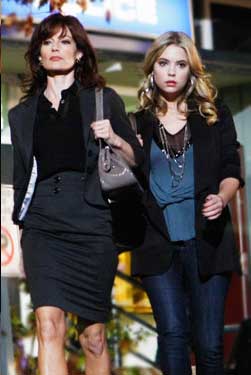
In happier news, Pretty Little Liars returns in less than a month and ever since I started watching it (so...since Thanksgiving weekend) I've been wanting to write something about why I enjoy it so much. What else am I going to do in the interim but overanalyze and rewatch, right? The thing with this show is that I didn't expect to actually enjoy it; I just figured it could fit into the gap left by Gossip Girl as fun, trashy, content-free television. Happily, that is not the case! Superficially PLL is a soapy teen drama, full of shoplifting, improbable outfits, deadly secrets, on-again-off-again romances, and familial troubles, but beneath the trappings and tropes is a pleasantly subversive show. Most strikingly, PLL provides something that is all too rare in pop media: an apparently-bulletproof core of female friendships. In most TV shows in this ouvre, whether or not one or all of the girls would turn on each other would be a major and probably ongoing plot point; this never comes up in PLL. Even toward the middle of season three, when Emily believes her girlfriend Paige is innocent and the rest of the Liars do not, their friendship isn't killed or even really shaken. All involved acknowledge that they're at odds in this matter, and go about trying to find out the truth, business as usual. Spencer, Hanna, and Aria's main concern is keeping Emily safe, not proving her wrong. The narrative actually plays into this in season two, starting off an episode with the four apparently squabbling and squaring off, only to reveal that they're fake-fighting in order to play A (their mysterious anon threat) by using A's constant surveillance of them against him/her. The idea that the four friends will ever "break up" is basically unfathomable. For my money, instead of taking interest away from their interconnected relationships, this baseline of faith adds tension. Will there ever be something A can throw at them that will make one of them crack? Why is it so important for them to remain friends? Is the glue of their relationship just Ali, or something more? Where is the line between close friendship and insular co-dependence?

(GIRLS. YOU GIVE ME SO MANY FEELS.)

Another area in which PLL deviates from the norm is in romance. Perhaps most notably, one of the Liars is gay, with more than one relationship and nearly as many intimate scenes with her girlfriends as the other Liars have with their boyfriends. Emily's coming-out experience is given lots of depth and time on the screen, and her relationships are as plot-significant as Spencer, Aria, and Hanna's. None of the girls are shamed by the narrative for their sexual choices--not even Aria, when it would be so easy for the characters around her to slam her with the "daddy issues" label--and none of them are punished in any regard for having sex (at least not yet...it remains to be seen what Toby's angle is).  PLL deals fairly with its male characters as well as the female ones, and I was especially fond of the initial portrayal of Lucas, who was allowed to be a decent human being instead of an opportunistic Nice Guy, though his current personality status is up in the air. You could argue that Hanna's first encounter with Caleb falls under the "sex turns men into monsters" trope, but she makes the decision to walk away, rather than having Caleb love-and-leave her. Their ongoing relationship is unusually equitable, with the only power imbalances coming from the secret-keeping that is the show's backbone (and thus can't really be done away with), and refreshing in its portrayal of a "bad boy" character who a) doesn't need to be "tamed" because he isn't actually a bad person and b) is forthright about his feelings. Interestingly, the show also goes hard for older man/younger woman relationships (Spencer is involved in some degree with all of her adult sister's boyfriends/fiances, Aria is in a relationship with her English teacher and also has some weirdness with Jason DiLaurentis, and it's implied in the mid-season finale of season 3 that the deceased Alison DiLaurentis had some sort of relationship with Byron Montgomery, Aria's father, as well as other older guys). But, again, the show doesn't present any of the girls as victims--not even Ali--and it's consistently implied or shown outright that Aria and Spencer hold the power in their relationships, rather than being preyed upon by adult men. A might try to hold the Liars' relationships over their heads as bait or threat, but the narrative itself is on their side. Toby, eventually Spencer's boyfriend, is a survivor of a pretty fucked-up relationship with his (villainous, oddly compelling) stepsister Jenna, and it's also pretty rare to see a male rape survivor on a "family" network show. His experience and its effects have yet to be fully examined on the show, but given the Big Reveal of season 3 so far, I'm betting the latter half will go into the wherefore of Toby's actions.

 
Finally there's the Hanna/Ashley relationship. Hanna is my favorite character and a good part of the emotion behind that is how she interacts with her mother, Ashley Marin. Truthfully, all the girls have really interesting relationships with their mothers, but Hanna and Ashley hit a bit closer to home, possibly because it's just them in the house, which is something I relate to. They have many shared attributes: fashion sense, pride, stubbornness, protectiveness--and they also have a certain armor that covers an instinct for generosity. After Spencer and Veronica, Ashley and Hanna are the pairing where it's easiest to see the mother's influence on the daughter, for better or worse. Watching their relationship develop in two and a half seasons has been far more rewarding than six seasons of Lily and Serena backstabbing each other and then falling back to "but we love each other because we're family" on Gossip Girl. Perhaps not as quippy as Rory and Lorelai or as moving as Joyce and Buffy, but certainly as cutthroat as Lily and Serena, Hanna and Ashley are up there in my pantheon of favorite moms and daughters. Here's hoping for a bit more inspection of Hanna's relationship to food and her mother's relationship to sex (no, really, I do wonder a bit if her romance with Pastor Ted will wind up being similar to Hanna's with Sean).


Pretty Little Liars isn't a perfect television show, but it's more than adequate as  both an engaging drama and commentary on pop culture and the socialization of teenage girls in the US. It presents a realistic situation for many teen girls wrapped in the ostensibly ridiculous premise of a friend's murder: that a person's entire world is watching them, waiting for them to screw up, itching to take them down or shame them in any way possible, gossip about them, be cruel to them or force them to be cruel to others, present them with an array of impossible choices. That is teenagehood for many girls--a claustrophobic atmosphere of nerves, indecision, judgment, and fear. At worst, PLL normalizes bad behavior--shoplifting, lying, blackmail, bullying (an accusation lobbed at many teen shows and one I don't have much time for); at best it invites discussion about those behaviors and their roots through the exaggeration and heightened stakes of the Liars' world.

Wednesday, November 07, 2012

Forward

Like most of America, I imagine, last night I sat up glued to my computer screen, downing far more local porter than advisable and scarfing pizza to stave off the anxiety that Mitt Romney might become the leader of my country. Fortunately, thanks to stubborn voters standing in lines for five hours or whatever gods might be smiling on us, Barack Obama retained his office with 303 electoral votes--including those of my new state, Ohio (yes, I cried tears of pride when those results rolled in--now if only Florida will match it!).


Beyond this happy news, the 2012 election also yielded a Senate majority for Democrats (let's hope they use it), and better yet, ousted or denied several members of the rightwing rape-enabling brigade: Elizabeth Warren defeated Scott Brown in Massachusetts and Claire McCaskill won against Todd Akin in Missouri. That the winners were female senators is just icing on the cake. Tammy Baldwin of Wisconsin took Tommy Thompson's seat, to become the first openly lesbian senator in US history, and Tammy Duckworth will replace Joe Walsh (another rape-enabler) and become the first US senator with a disability. Anti-marriage amendments were struck down in four states and Massachusetts legalized medical marijuana, while Colorado and Washington legalized it for recreational use, with limits.

All in all, it was a pretty good night. President Obama isn't perfect--he certainly isn't as wildly progressive as some reactionary types like to imagine--but waking up this morning to four more years was a good feeling. It is good to think that there are voices in this country that outlast the lunatic fringes and that voting shenanigans can't always keep democracy down. Now we have four more years to get the things done that matter, four more years to work for education initiatives, healthcare, and true civil rights for all our citizens, four more years to work on ending our various fruitless wars. We elected many great people yesterday: now we have to hold them accountable.

Tuesday, August 28, 2012

The case for Wonder Woman's virginity

Now. I don't mean that Wonder Woman has never had sex or should never have sex. But I do think there's something to be said for using a different definition of "virgin" when considering the Amazon, a la Marilyn Frye. In this meaning, a woman may have sexual relations but, if unmarried or unpartnered, is considered a virgin, she who is without fetters, not under anyone's control: the willful virgin.

(she dates herself...)

This is the light in which I prefer to read Wonder Woman, for several reasons. First, this definition allows for same-sex relationships, which is useful for people who read Diana as a bisexual or lesbian woman (as I do). Furthermore, it allows for a woman having multiple sexual partners or no sexual partners, according to her lights. I like this because I view Wonder Woman as loving both men and women--but chiefly women--and also as having no particular interest in long-term relationships. Part of the reason that I find the new Superman/Wonder Woman As Official DC Power Couple so distasteful is that I don't see much in Wonder Woman's persona that is interested in being with one person. Her love goes elsewhere; it can be directed to a child in need of help or whole countries. She loves everyone, as a goddess loves. And like a goddess, she might take a consort for some time, or she might not. 

(she's authoritative...)

Taking her original origin (I am also serenely ignoring her new origin), Diana is gifted by the Greek deities to be "as beautiful as Aphrodite, as wise as Athena, as strong as Hercules, and as swift as Hermes," as well as receiving other blessings from deities such as Demeter and Hestia. All told, these gifts combined with the love and will of the Amazons create a demigoddess who is very similar in many ways to the goddess Artemis, and even shares her Roman counterpart's name, with Artemis and Diana being two of the most well-known virgin goddesses. Pre-Olympian stories indicate that Artemis occasionally loved humans; the stories of Orion, Endymion (where Artemis and Selene are considered to be two parts of a tripartite figure), and possibly Actaeon fit into this scheme, as do the numerous nymphs and maidens Artemis had about her as companions and supernatural/divine versions of Sappho's colony on Lesbos. The pre-Olympian Artemis is the quintessential willful virgin, and as her avatar on Earth, Wonder Woman is too. Both are active, powerful, complex female figures whom misguided souls attempt to cram into too-small boxes.

(...but always diplomatic, even in war)


Seeing Diana placed in a heterosexual long-term relationship grates. Romantic relationships are not the be-all end-all of female characters; heterosexual sex is not the only sex; sex and relationships don't have to go hand in hand. And let me be frank: I ship my lady with a whole slew of people, from Batman to older versions of Dick Grayson, from Batwoman to Power Girl. It's very easy for me to imagine her in the throes of passion--she isn't sexless--but my reading of her personality and her life and her mission is that she won't be distracted for long. She won't give in to relaxation and pleasure when there's work to be done. And she won't tie herself to another person, because she belongs to the people and the world first. Most importantly, she belongs to herself.

Monday, August 13, 2012

Geek Girl Con 2012

This past weekend I was lucky to be able to travel to Seattle and attend the second annual Geek Girl Con gathering. I was prepared for awesomeness, but not quite the level of great that occurred. It was definitely the best convention experience I've had thus far: excellent and varied programming, some truly sweet guests, an exhibition hall where I wanted to buy something from every table, an astonishing amount of talented cosplayers, and general good vibes.

I met literal social justice warrior Purple Reign and her partner Phoenix Jones; I attended panels about disabilities in comics and other popular media, feminist concerns in YA literature, creating well-rounded characters, and gender and race in The Hunger Games; I chatted with three of my favorite comic book writers (one featured below); I hooked up with amazing Internet friends; and I managed not to empty my bank account on swag.

(your faithful blogger with Greg Rucka. Yes, THAT Greg Rucka)

It was a wonderful view into a portion of fandom that is motivated, thoughtful, smart, talented, and passionate. I really hope I can go back next year, and every year after. If you'd like to see some of the pictures I snapped (mostly beautiful cosplay), check out my Tumblr and the official con Flickr. I also have a couple of posts about the con experience up at my other blogge and the comics website Between the Panels.

Sunday, July 29, 2012

Happy birthday, Gail Simone!

Today is the birthday of one of my favorite comic book creators, Gail Simone. Simone has written all of my favorite characters at one time or another, including Wonder Woman, Renee Montoya as the Question, Deadpool, and of course the superteams Birds of Prey and Secret Six...and she recently got to use Batwoman in the Batgirl title, an issue I'm very much looking forward to!


She's one of the best DC Comics has got and I wish her many happy returns. Have a great birthday, Gail!

Wednesday, July 25, 2012

Godspeed, Dr. Ride

In case you missed the news, Dr. Sally Ride passed away on Monday. She was sixty-one years old.

Being that Ride was the first American woman to travel in outer space (as well as the youngest astronaut, aged 32 at her first flight), I heard a lot about her growing up on the Space Coast. She was a staple of Florida history classes and science lessons. As an adult, I have even more admiration for this remarkable woman and her legacy. She did much to break barriers for women in the sciences and provides a wonderful example for youth to look up to.

If you'd like to learn more about Dr. Ride, check out Sally Ride Science.

Friday, June 29, 2012

Brave (spoilers)

So, apparently a lot of people didn't like Brave. I will be honest: I don't understand where most of them are coming from, but then I have never been one to fellate Pixar the way a lot of people do (what's the point, when Studio Ghibli exists for all your absolutely fantastic animated film needs?), and it seems that a lot of the criticism is based in "this is a good Pixar film instead of a great one and we are used to Pixar making great movies."

...ok. Well then, from the perspective of someone with no bar for what Pixar films should be: I really liked Brave. As far as this summer's fairy tale movies go, Brave is one thousand times greater than Snow White and the Huntsman. The animation is beautiful--everything you have heard about Merida's hair is true--and I thought the story was very solid. But I like fairy tales! And princess movies, despite all of Disney's flaws! If you aren't into either/both of those things, YMMV with Brave. Here are a few things I specifically enjoyed:

1. Merida and Elinor. It is...hmm, pretty rare in TV and movies to see a thoughtful presentation of mother-daughter relationships with neither side unfairly demonized, and even more rare to find this in what is in many ways a quintessential fairy tale kid's movie (Disney loves its evil/absent mother figures). Elinor and Merida have a pretty realistic relationship which I imagine lots of viewers of the film can relate to--they squabble about how Merida should act, how she would wear her hair and her clothes, and what she should be when she grows up. Shockingly true to life! I was surprised and pleased to find the movie revolving largely around the mother-daughter relationship as it changed through Merida and Elinor's actions--because that is what this movie is about: the part of growing up that means you have to deal with your mom as a person, and she has to deal with you as a person. It's about realizing that your mother isn't infallible, and that your daughter isn't an extension of yourself. I found it very satisfying to see Merida and Elinor come to an understanding and compromise. And yes, I was very scared that Elinor would stay a bear! Oh man I was so nervous. TEARS EVERYWHERE.

2. Fergus and his family. Fergus, Merida's father, managed to straddle the line between goofy Scotsman archetype that we're familiar with and all-around good dad and husband. It is clear that he and Elinor are in love, and that he's a great father to both Merida and his three small sons. He's an effective ruler, he has a good sense of humor, he's brave, and he's loving. I want Fergus to be my dad!

3. The animation. Now, one of the reasons that I'm not a ginormo Pixar fan is that I vastly prefer traditional cel animation. That said, the animation in Brave is fantastic, really beautiful. Merida's hair, as mentioned, is very notable, as are the gorgeous forest and water backdrops. I found Angus, Merida's horse, particularly impressive, and the will o'the wisps that lead Merida on her quest were charmingly eerie. 

4. Holy shit, no prince?? No prince! Well, actually there's three sons of Scottish clan lords, but none of them marry Merida and none of them are important characters. This film is not about princes: it's about Merida and her personal journey. Refreshing.

Merida defending her mother, via  Pixarblog
 
And the princes bring me to my final point, which is both a good and a not-so-good thing: gender! Yay gender, everyone loves talking about gender, especially in Disney films. See, Merida is really good at some traditionally "manly" pursuits, including archery and serious rock-climbing, she doesn't like sitting still or wearing pretty clothes, and she eschews getting married, so some short-sighted people think she must be gay. That isn't what I'm concerned with, although if there happened to be a Brave sequel where Merida was indeed involved with a lady, well, that would be nothing short of a miracle. Still, beside the point. The major conflict in the film stems from Merida's ideas about what she wants to do with her life versus her mother's. This is not unfamiliar territory, but the way in which it is resolved I found interesting. Ultimately Merida and Elinor reach a compromise and work together to solve their problem of how to settle the clans without Merida having to marry any of the clan lords' sons. This scene is really sweet, I thought, involving Elinor (in her bear form) coaching Merida through what is really her first diplomatic speech to four reasonably het-up leader men. This is good practice for Merida's eventual queenship, and also signifies that she and her mother are reaching a place in the middle where they can work together with their separate strengths and ideas to present a unified solution. 

But there's one more problem: Elinor is still a bear, oh noes! The climactic scene combines the things that are great about both women to protect their families from the monstrous bear Mor'du and to turn Elinor back into a human. Part of this involves Merida repairing a tapestry of she and her parents which her mother had sewn and Merida had torn in anger, part of it involves bear!Elinor fighting Mor'du, and part of it involves Merida using her bow against Mor'du and defending her bear-mum from angry and terrified Fergus. A lot of people, it seems, did not like the tapestry-repair angle, as they saw it in terms of Merida capitulating to traditional femininity, but I saw it as more of that compromise between the past and the future, a blending of where Merida comes from (her mother) and where she's going (who knows? That's part of of the fun of growing up!). Elinor is never painted as a bad mother, only as one who has strong ideas about what she wants for her child, and Merida is never painted as a bad daughter, only one with her own, pretty teenage-typical, ideas about what she wants for herself. 

These are good things, by my lights. It's a good message in a good movie. Brava, Brave. Honestly, this movie hit me where I live, I think because anything that goes beyond the surface of moms and daughters gives me All The Feels. No, issues with forced marriage are not out of date in 2012--not even in the US and certainly not in many, many other countries. No, not everyone has a rosy relationship with their mother. Not everyone reconciles and not everyone even wants to reconcile, but seeing Merida and Elinor make it up and move forward together is really touching. Am I wrong in thinking that some of the dismissal of this movie stems from dismissal of women's stories and relationships?

What makes a queen?

Assuming a reading order of The King's Peace, The King's Name, and The Prize in the Game, the reader first meets Elenn ap Allel in The King's Peace, when she arrives in Tir Tanagiri as Urdo's queen. Thus for two books we see her only through the eyes of Sulien, who likes Elenn but doesn't understand her very well. They are two wildly dissimilar specimens of womanhood. It isn't until The Prize in the Game that the reader finally gets a glimpse into Elenn's head, as well as viewing her through the eyes of other characters who know her well and yet not at all. The reading order of these books doesn't really matter that much, but I imagine that reading The Prize in the Game first would be an interesting experience. Regardless, Elenn's complexities are hinted at in the Sulien duology and elaborated on in full heartbreaking spectacle in Prize.

Elenn is a queen who has been raised to be a queen. She has never thought of being anything else; indeed she admits this to her friend ap Ringabur, a lawspeaker of Tir Isarnagiri. However, that conversation is also notable for Elenn considering her options (as a warrior, a lawspeaker, or an oracle) and then deciding that yes, being a queen is actually what she does want to do. Her sister Emer is more akin to Sulien, though again very different in significant ways, in that all she's ever wanted is to be a warrior and dreads the thought of being a queen, though ultimately she is forced into it. Emer and Elenn approach queenship from vastly different perspectives. Emer is doomed to her crown, having married Lew ap Ross when she believed her beloved, Conal ap Amagien, had been killed; though she is a good queen for her people, she is at heart a warrior as well as being a woman in love (Conal isn't really dead, of course), and these traits combine to sometimes cause her to do things which confuse Sulien and enrage Elenn. On the other hand, Elenn is on the surface the quintessential fairy-tale queen: fantastically lovely, with songs and poems written to her beauty, composed at all times, capable of small talk and soothing the egos of important men, intelligent and savvy and generally good at running the day-to-day nuts and bolts of a castle. Indeed, the first we hear of her is a description of her beauty from Gwyn ap Angas, who opines that Elenn is "strictly the decorative type" of woman; in Prize Conal compares Emer to her sister, with Emer coming out on top for having "more wit than hair"; and Sulien confirms Elenn's beauty when they first meet--but in that same meeting, Elenn's first words within the text of The King's Peace are a polite, pointed speech in which she tears the Jarnish lord Alfwin a new one for refusing to meet with Sulien and Marchel, two of Urdo's war-leaders and most trusted personnel (Alfwin's words: "Women don't conclude alliances." To his credit, he becomes more used to the Tanagan way of doing things when his niece Alswith becomes a decorated warrior and king in her own right). Clearly there is more to Elenn than her nearly supernatural beauty. She is trained in fighting and chariot driving as a matter of being an Isarnagan noble, but the martial arts are not where her interests or strengths lie. When Urdo marries her he gets not only an alliance with a kingdom of Tir Isarnagiri but also a woman bearing every queenly aspect and accomplishment.

...except one, and it's the big one: fertility. Every queen is assumed fertile until proven otherwise, and Elenn, sadly, is proven otherwise. In her years married to Urdo she produces no heirs, and only conceives once, miscarrying due to the subtle machinations of Morthu. This is the great sadness of her life,  perhaps compounded by a revelation in Prize that she was born "at the Feast of the Mother" (around the beginning of February, when the goddess Brigid was celebrated with the festival Imbolc) and felt a certain closeness to that goddess. Ultimately being infertile might have caused even more pain if Elenn felt that the Mother had forsaken her. Unlike the other Guenevers she is modeled on, she doesn't turn to any other man, whether out of grief, love, or belief that maybe Urdo is the problem. After the events of Prize, one suspects that childlessness is the final nail in the coffin of Elenn's self-esteem, given that  her mother Maga effectively whores her out to the warriors of Tir Isarnagiri in exchange for them fighting for Connat's side against Oriel, and Morthu later uses manipulations similar to Maga's to turn Elenn against herself. Worst of all, one of the warriors  used by Maga is Ferdia, the man Elenn truly loves and closest friend of Oriel's champion Darag. She is aware that he only marries her because Maga blackmails him into it; his sense of honor allows him to be shamed into the marriage and then into fighting Darag (as the text suggests, the person he truly loves). This knowledge is devastating to Elenn. The very things she has to hold onto, the things she has been raised to value--her beauty, her skillset, her position and responsibilities as a princess, her goodness and pliability--are used against her, first by her mother Maga, then by Morthu. In a horrible scene reminiscent of the events of The Prize in the Game, Morthu appears to have intentions to marry his king's wife, referring to her as "dear one" and other endearments, and attempting to kiss her as Sulien and  Ulf Gunnarsson watch helplessly. This scene, taken with an earlier one in which Morthu uses evil magic against Sulien, implies that Elenn's mind is undergoing a form of molestation stemming from Morthu; since we have no view into her imprisonment with him, it is unknown whether her body has also been violated. Morthu, like Maga, is able to exploit Elenn's upbringing and her beliefs about her status, position, and purpose, as well as her general isolation; despite the strides she has made with Urdo in terms of trust, once subjected to the brand of manipulation Morthu wields, Elenn's walls go right back up.

As Sulien, Darien, and Urdo state on various occasions, Elenn is the ultimate queen. She is everything a queen should be and everything Urdo could want in a partner, and he truly doesn't care that she has been unable to bear children, beyond his care for her heartache. But as the poem from which The Prize in the Game takes its title states, "they wear my favor but my arms are empty"; this can be taken to signify that though she has many husbands, they are never hers to keep (the warriors of Tir Isarnagiri are married to Elenn, then go to their doom at the hands of Darag, who is undefeatable--Urdo is rarely at home, being busy keeping his kingdom in order). Further, despite her many wedding nights, she has no children to fill her days and heart. Her arms are empty. In spite of this, the idea of Elenn visiting another man's bed is never brought up, either by her or by Urdo, who mentions it as an impossibility to Sulien; instead Urdo and Elenn are firmly loyal to one another, making Elenn's grief over her childlessness all the more palpable. In most Arthur stories, from the medieval romances onward, Guenever and Lancelot are--overtly or covertly--the cause of the downfall of Camelot. The Sulien books dispense with this plotline entirely (though a lesbian romance between Sulien and Elenn would certainly be an interesting interpretation, had Walton chosen to keep the Guenever/Lancelot relationship), though a subtle twist through rumors is presented: that Sulien and Urdo had an affair prior to Urdo's marriage, and Sulien's son Darien, the stand-in for Galahd--who notably is not known as "Darien ap X" but as "Darien Suliensson"--was fathered by Urdo. Elenn becomes somewhat obsessed with this rumor, her fears stroked by Morthu, though it is well known that Sulien eschews all sexual relationships. In another nod to traditional Arthurian stories, Morthu also encourages the rumor that Sulien's son is the product of incest between her and her brother (as Mordred was the product of Arthur and either Morgan or Morgause's incest). In a very moving scene, Emer and Sulien speak with Elenn and point out that if Darien isn't Urdo's son, then Urdo and Sulien were never lovers, and Elenn at last opens herself to the possibility of truth without fact.

Dispensing with the familiar story of Arthur's cuckoldry also dispenses with the crumbling of the kingdom. At the end of The King's Name, Morthu is defeated, the King's Law upheld, peace restored, and though Urdo has passed on, his crown passes to Sulien's son Darien. As Sulien relates at the beginning of The King's Peace, the Peace they created remained; this is not the story of Arthur and Camelot we are familiar with, but it is a pleasing newness, the idea of shining Camelot enduring to become a truly united land. Ultimately Elenn finds peace as well, reconciling with both her sister Emer and Sulien near the close of The King's Name and seeking solace in her relationships with them and her religion (true to legend, she enters a monastery and eventually becomes its leader). Knowing that Elenn is a woman with major trust issues, it is with hope and tenderness that Sulien suggests Elenn found "trust and healing" with the monks. As a reader, I hope she did too.

Wednesday, June 27, 2012

Distressing damsels

With title credit to the inimitable Carrie Fisher, all the damsels in the Sulien books are somewhat distressing. Certainly Sulien herself, who is called a demon by followers of the White God and a walkurja (valkyrie) by the Jarns, is about as distressing a warrior as one finds in fantasy literature; her tendency to laugh and scream during battle combined with her fighting prowess and great leadership make her an amazing character of strength, while her bluntness, simple desires, and social ineptitude make her an appealingly human one. Marchel, another female praefecto, is fanatically religious, a fearsome fighter and great horsewoman, and ultimately a traitor who kills surrendered enemies--there is much that is distressing about her. Emer, queen of Dun Morr, is a celebrated charioteer and warrior of Tir Isarnagiri, who drives the greatest Isarnagan fighter, Black Darag, in his fight against the warriors of Connat, and raises her daughter to become the greatest armiger of her time. And on the side of fearsome non-fighters, because well does Walton understand that "strong female characters" doesn't always mean "strong female characters," there are women like Veniva, Elenn, Morwen, and Garah: Veniva (Sulien's mother) is called "the last of the Vincans" and is devoted to keeping the fires of civilization alive in Tir Tanagiri: she insists that her children learn to read and write, and puts much stock in the great Vincan traditions and laws; Elenn, of course, is the ultimate queen and a woman of many varied and useful skills; Morwen is also a great queen and likely a good mother in her way, if also a sorceress who consumes souls to fuel her power; and Garah, loyal Garah, is talented with horses and healing, becomes a skillful queen, and it is stated that she coordinates the mail system in Urdo's kingdom, with an undercurrent of possible espionage work (this might just be my wishful reading).

There are only two instances in which any of the women of the story can be said to be in distress: first, the opening of The King's Peace, when Sulien is set upon and molested by Jarnish raiders, and second, near the climax of The King's Name, when Elenn is under Morthu's hypnotic spell. In both cases it is by the efforts of the women themselves that they are freed (though Sulien receives some assistance from her brother Darien before he is killed by the raiders). Elenn, fulfilling all the outward steretypes of a fairy tale princess, would seem to be the damsel most likely to be in continual distress, but this is not the case. Despite what Conal and Emer think of Elenn at the outset of The Prize in the Game, both ultimately come to view her with understanding, if not exactly liking. Princesses in fairy stories are often damsels in distress, requiring rescuing from a slew of monsters, evil witches, and knights with ill intentions. They are almost without variance rescued by knights with good intentions, whom the princesses duly marry. In the Sulien books, we see a few of these tropes in the cases already mentioned, as well as when Elenn is "rescued" from Tir Isarnagiri and her horrible parents (seriously, Elenn, get rid of your parents, they are revolting) by marriage to Urdo, an honorable knight if there ever was one. Maga, Elenn and Emer's mother, certainly fits the bill of evil sorceress, as it is hinted that she intends to force Emer to do what she wants by use of magic, and uses Elenn as the ultimate pawn in her game of war with Oriel. However, Walton's books give more time and attention to why Maga and Elenn act the way they do, and the emotional as well as physical consequences of their actions, where most archetypical fairy tales show the trapped princess from far away, in the view of the prince/knight, and then her happy rescue and romantic wedding. Analysis within the text is rarely given to the princess's mental or emotional state. In the case of Elenn, although Sulien doesn't always understand her queen, she provides enough details about Elenn's behavior so that, in conjunction with what Emer and Conal feel about her and the details the reader receives firsthand through Elenn's passages in The Prize in the Game, we as the audience understand and feel for Elenn deeply (I hope. Honestly if you don't, you are probably a Borg).

In The Prize in the Game most heavily and somewhat in The King's Peace and The King's Name, much narrative time is spent in Elenn's mind, such that the foreword for Prize states that if you don't understand why Elenn does what she does by the time you've finished reading, Walton washes her hands of you (I paraphrase). Indeed that book specifically and the triptych in general seem a response to both the familiar fairy tales of old as well as more modern reworkings; the Sulien books are a skillful blend of age-old tropes and contemporary considerations. Elenn can be both the princesse lointaine, the faraway princess and the distant queen on the hill, as well as being a savvy diplomat, a frightened yet proud wife and daughter, and a beloved queen, and answerable ultimately to her own lights.

Monday, June 25, 2012

Here's the thing

I have been trying for almost four years to write something smart about The King's Peace, The King's Name, and The Prize in the Game by Jo Walton. These three books are well worth a full academic perusal, but my brain is so amazingly out of shape since I left college. My own fault, I suppose. I have always wanted to examine the role of the princess/queen figure in fantasy and fairy tales, and how that role is fulfilled and subverted by Elenn, as well as the other major female figures, in these books. And this year so far I've reread the triptych twice (I'm on the third go-round), each time with saintly intentions to read slowly and carefully, making notes, jotting page numbers, and generally being critical.


This just...doesn't work. I have consigned myself to being totally uncritical where the Sulien books are concerned. Even though by now I've read each of them probably ten times, I just can't not get caught up in the stories. Simply too good. So instead of my intended Gleaming Academic-Quality Superpost, you get a Jumble-of-Somewhat-Related-Thoughts Superpost. As ever, read or ignore at will.

First, a little background on the world of Tir Tanagiri and Tir Isarnagiri is needed for those not familiar with the Sulien books. Briefly, an alternate-mythology version of Arthur's Britain is presented and peopled with characters almost familiar from our own Arthurian myth cycles: Urdo is the glorious king, Sulien is his right hand (Lancelot, effectively), Gwyn of Angas is Gawain and Mordred becomes Gwyn's brother Morthu, and Elenn ap Allel, an Isarnagan (Irish) princess, is the queen Guenever. Two major legends, that of Arthur's Camelot and the Irish story of the cattle raid of Cooley, intersect at a few points and form the bulk of the three books. Overall it is an elegant and natural reformation of tales familiar to many.

This world has what I suppose to modern eyes looks like near-total gender equality; women fulfill the occupations of warriors, healers, keykeepers or stewards, farmers, priests, merchants, ambassadors, and every other walk of life necessary to the functioning of a kingdom. Most notably, perhaps, is that women can hold the kingship of their ancestral lands and are referred to as "kings" or "lords" without an eyeblink or discussion of whether the term is gendered. For instance, Sulien is eventually the lord of Derwen and is termed "king" by one of her fellow armigers; across the water the word king is thrown around even more casually, as both Maga of Connat (Elenn and Emer's mother) and Conary of Oriel are kings, and the major characters often discuss what it's like to be king and whether one would rather be a king, a warrior, a queen, or something else. Within the ranks of Urdo's armigers, women are as accepted as men for the fighting life and often reach high rank, Marchel and Sulien as praefectos (a title akin to general) being the most obvious examples. Rape isn't allowed even "in the usage of war" and is punishable by law in either war or peace according to Urdo's law; the Tanagan armigers are horrified to learn that the invading Jarns rape as a matter of course in their warfare. Furthermore, extra-marital and pre-marital sex are normative in Tanagan and Isarnagan culture (In The Prize in the Game, a threesome between Darag, his wife Atha, and his best friend Ferdia occurs with little to no fanfare from anyone), and if homosexuality is not found as often as heterosexuality, neither is it looked at askance. Sulien is somewhat of an outlier in that she is asexual, with the bulk of the Tanagan armigers coupling at will, apparently with few issues arising (the Pierce fanatic in me harks at this point to a conversation in Squire between Kel and Buri, wherein Buri states that, in the ranks of the Queen's Riders, male subordinates offer to "work things out in bed" with their female superiors). An interesting conversation does occur between Osvran, a (gay) man, and Sulien, in which Sulien points out that a fellow female armiger, Enid, after marrying had to request that she still ride with the ala, when it was her right to do so and not her husband's decision. However, beyond this we don't see much barring the major female characters from doing as they wish; no one doubts Sulien and Marchel's fitness to command (until Marchel's ignominious downfall, anyway), ap Rhun is accounted one of the best key-keepers in the land, and Emer is considered more significant in terms of alliance and war-making than her husband Lew, a king.

There is also a certain burgeoning flexibility as far as class in Tir Tanagiri goes. One of the most notable supporting characters, Garah, goes from being a groom in Sulien's family's stables to becoming a queen married to an armiger gifted with empty land--a king. Both Garah and her husband Glyn were "commoners" who rose to power. This isn't accepted by everyone--indeed it is part of what tips off the civil war in The King's Name--but it is part of Urdo's vision for what Tir Tanagiri should be and is regarded by both detractors and supporters as inevitable change. The admixing of disparate cultures and religions is also an inevitable change coming to the land; the old "pagan" religions of the Tanagans and Isarnagans meet with incoming pagan religions of the Jarns as well as the new religion of the White God (thinly veiled Christianity), and the ways in which each king deals with this make up significant plot points and considerable background for the story. As High King, Urdo stands between all the gods of Tir Tanagiri (we meet a few of them, including the great boar Turth and Coventina, Mother of Waters) and it is his duty to force neither the gods nor the people to any path they don't wish, despite the pressure of the White God's church.

Walton does virtually no feminist preaching in these books; it isn't necessary, since the very structure of the world is close to being a feminist ideal. It's a matter of reality that there are both gods and goddesses, female priests and monks and male ones, female warriors and male healers, female kings and male charioteers, female lawspeakers and male cooks. There are villainous women, such as Morwen and Maga, and villainous men, such as Morthu and Borthas, and all significant characters are given rein to grow and change. Characters make plot, and Walton's characters are no exception. The motivations and deep personalities of such complex characters as Ferdia, Elenn, and Morthu create the plot through their machinations and impulses. Even the glimpses we see of the future of Tir Tanagiri shows that despite the eventual rise of the White God's church over the island, the position of women remains steady; Sulien speaks of great female armigers and lords she knew in her old age. Urdo's peace built on and strengthened a foundation of equality which covered all people, creating a bright world which could almost be our own.
Related Posts Plugin for WordPress, Blogger...