Flip Through

Showing posts with label Music. Show all posts

Wednesday, September 04, 2013

Crescendo of gratitude

There are two parts to enjoying a live concert: the anticipation and the experience. Savoring the idea of what's to come takes up weeks or even months beforehand for me, the feeling growing as I drive to the venue. It builds and builds throughout the opening acts (Eklipse, you are awesome; Delain, you are delightful), and finally you get to let go when the headliner takes the stage. And when the act in question is your favorite in all the known multiverse, the entire shebang levels up. As mentioned in a few previous posts, Kamelot's got a new lead singer, and while they technically toured last year, that was a supporting tour. With a truncated set-list, and no new album to promote.


(Karevik and Alissa White-Gluz, taken by glitzandshadows)
 
But this year is different. This year is the tour of the first post-Khan album, and the band's first international headlining tour with a new singer. THIS YEAR IS A BIG YEAR. I'm so glad they chose to kick off their continental US road trip in our own Columbus, Ohio. There's a lot to be said against live music: eardrum-destroying, obnoxious people talking behind you during the ballads, waiting in all kinds of weather to get inside, $7 beers and expensive merch. But the ecstasy of a crowd and the chance to sing along and the goodwill that communal excitement fosters are more than enough reward. Live music gives you a chance to see performers' most glorious heights, but also their foibles--fumbling a bow, screwing up a lyric, recovering with a smile. Live music is cathartic. Maybe it only lasts four hours or so, but the hangover is legendary, to the point where there's no listening to other music for a few days after, for fear of blurring the amazing performance still going on in your head.
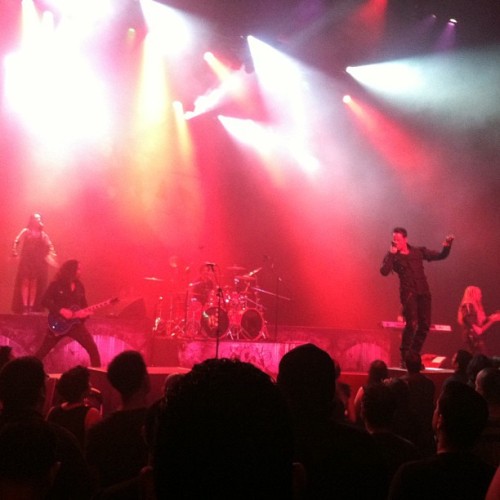
 
(the band, taken by marssimons)
 
And it was a great performance. If there was any doubt that Tommy has the stuff, this tour will kill it. If there's resentment or even apathy toward him, I didn't see it in the crowd in Columbus. We might not have filled the (relatively small) venue, but we were loud. We sang to every song, we headbanged and air-guitared and yelled. The next day at work, someone asked me if I a cold. That's a successful concert experience. May the rest of the tour be as awesome for Kamelot as Monday night was for Columbus, and may their new frontman continue to help carry and build Kamelot's legacy.

Friday, April 05, 2013

Justify the malice, or, How many links can I fit into one post?

For awhile there I was distracted by Tegan and Sara and Leprous, but true love lasts a lifetime and my favorite power metal sneak feminists, Kamelot, are perfect for every season. Part of this is that Tumblr user thesiegeperilous is in the process of posting a series on the female gaze in heavy metal (one of which posts links to my own Kamelot superpost, oh my how I blushed!), and so I've been thinking about image, how groups in these genres portray themselves, and how they might consider their fanbase and fan expectations when creating those images. Though according to Deena Weinstein the male to female fan split is fairly even, the majority of metal performers are male and--as in most media--the product is largely aimed at male audiences...or rather, the default audience, which is assumed to be male. As Stephanie Green points out in her very good 2009 article on Strange Horizons, despite a significant presence female fans may often be marginalized or have their fandom policed (as I noted briefly a few months ago). If, as Green posits, "metal's themes center on untamed masculinity in all its forms," does a female gaze even exist within the music? Why would I refer to any metal band as feminist, even a sneaky brand? On the surface, Kamelot does not appear to meet the criteria: the major female characters in their songs have a tendency to die, and mainly male desires and character arcs are considered. However, two songs from very different eras present a more nuanced view into the band psyche--the "Elizabeth" trio and the four-part "Poetry for the Poisoned." Furthermore, the characterization of Ariel on The Black Halo can be read as, if not created for the female gaze, then an inversion of the male gaze. 

First, Karma's "Elizabeth": nominally about the notorious Elizabeth Bathory, the song is, in Khan's words, about beauty, vanity, and growing old. Within this frame, the song can be interpreted as an examination of beauty standards for women in place since time immemorial, and how straining to meet kyriarchal expectations turns women against one another and against themselves. According to legend and as portrayed in the song, Bathory murdered young women in order to use their blood to preserve her own beauty and youth. Kamelot's rendition is somewhat more sympathetic; the lyrics show a woman full of pride, doubt, and fear, trapped by actions carried out in order to free herself from "the vicious hands of time." American culture dictates norms for women, from our appearance to our sexuality to how we raise our children, and typically these norms are narrow indeed, based around an ideal of fairness (where beauty is white), thinness (where health is unimportant), innocence (where malleability is prized above self-esteem), and availability (to the right men, at the right time). It's easy enough to see myself in Elizabeth, to imagine the demands placed on me carried to their logical extreme. How far are we willing to go to make ourselves desirable, in a culture where a woman's worth is measured by her desirability? Authorial intent is always a murky topic, but I read "Elizabeth" as a song created by someone who was in fact interested in concerns like these, who saw a need to ask what would drive a woman to murder repeatedly, with a specific end goal in mind. As a listener I am free to derive my own meaning from songs, and while I have no idea if any of the band members would take the label "feminist," the "Elizabeth" trio is significant to me through the lens of feminism.

Next, the Ariel question. During Epica, Ariel is presented as a typical masculine hero-on-a-quest: he's active, he has goals, he loves but he sets aside that love in favor of his journey, his lady is fridged for his emotional testing, etc. The Black Halo continues the quest, but Ariel's position has shifted slightly. Beginning with the Epica song "Descent of the Archangel" and continued in "March of Mephisto," "When the Lights Are Down," and "The Haunting," Ariel is acted upon, placed in a position normally occupied by women. Indeed, "March of Mephisto" specifically indicates that Ariel is being seduced--by multiple personages, no less, as his seduction is two-fold and carried out mentally by Mephisto and physically by Marguerite. Now, the plot breakdown of this album as posited on Wikipedia diverges somewhat from my interpretation; it emphasizes that Ariel seduces Marguerite under Mephisto's influence, but it is also indicated that Mephisto delivers Marguerite to Ariel (is that enough italicization?). So for me, Ariel's mental/spiritual assault by Mephisto in conjunction with Mephisto maneuvering Marguerite like a chess piece trumps Ariel's autonomy. In effect the positioning of Ariel gives listeners a two-pronged fantasy: those attracted to women (Marguerite) can imagine themselves being seduced by her, and those attracted to men (Ariel) can imagine themselves seducing him. Ultimately, though the songs and accompanying videos showcase very beautiful women--including the flawless Simone Simons, who really deserves her own post someday--which is normative of androcentric heavy metal, the main male character is not in the typical position of power-over. Lyrically the songs don't stroke Ariel's ego or glorify his relationships; rather they pin the blame for Helena's death and his own downfall squarely on Ariel. Tracks like "This Pain" reveal an awareness of how non-sanctioned sexual relationships affect women, both in the medieval period Ariel is supposed to be part of and in good old 2013. On the flipside, since Khan's voice and appearance are the vanguard of Kamelot, suggestive lyrics come straight from the horse's mouth; the teasing nature of "Descent of the Archangel," the romance of "Forever" and "Temples of Gold," and the lust behind "March of Mephisto" all have an attraction magnified by the fact that they are sung by a beautiful and charismatic performer. Similarly, the "you will kneel before me" line from "Veritas" capitalizes on Tommy Karevik's physical and sonic appeal.

Finally, Poetry for the Poisoned's title track. It's no secret that I am fond of this album, a release decried by many fans, and part of it is that I hear it as darkly reflective of Ariel's journey on Epica and The Black Halo; the main character on the title track is very similar to who Ariel would have become had he fully succumbed to Mephisto. Beyond this, the record features two unnamed female characters who differ greatly from Helena and Marguerite. Though "If Tomorrow Came" is my favorite song on the album--largely for featuring that singular woman--more interesting to interrogate is "Poetry for the Poisoned" itself. The spoken word bit at the end of Part I sets the theme up nicely, making quite clear that this song is about sex and sexual appetite, but Parts II and III turn the female voice into the subject and the male voice into--well, not quite an object, but into someone who is acted upon as he acts upon the woman. It is rare enough in Kamelot lyrics to see a woman acting out, and rarer still in metal lyrics generally to see one whose sexuality is not necessarily objectified or demonized. Not to say that this doesn't occur in "Poetry," but presenting a female character who glories in her sexuality and her physical power is a noble goal--particularly if she is not ultimately punished for it. And even beyond this, the song can be read as a revenge story, as it ends with the male character's death and "life in slow review" as he considers what's brought him to this place. Not only is the female character still alive at song's end, she's been empowered to strike back at someone who assaulted her and assumed she would provide satisfaction for him and nothing more. Of course there are less charitable interpretations of this song, but as a fan of so-called weaponized femininity, I like mine.

No band, actor, writer, or filmmaker is perfect; most of the time I have to analyze the media I'm consuming and see if there's enough There there to make it worth my while. It's entirely possible to be a fan of problematic things; it's why the gods blessed us with critical faculties. And while there is material in Kamelot's catalogue to take issue with, there's also enough thoughtful, unusual material that I feel confident that the band are aware of their non-straight-male fans and are interested in not alienating them, in creating narratives that don't always privilege prototypical male sexuality and that present cognizance of  female desire. 

Monday, December 31, 2012

Year's finest

I have returned from winter rambles...with A List. Behold my Top Ten Various Awesome Things of 2012 in no particular order, because real blogging what's real blogging?

10. Favorite Cover of "Black Betty": Gypsyhawk (live at the Old Towne in Pasadena). So. Much. Hair.

9. Favorite New Ongoing Comic from One of the Big Two: Captain Marvel, motherfuckers. Kelly Sue Deconnick and Company (including the Dodsons, Jamie McKelvie, and Emma Rios) knock it out of the park twice a month with the Carol Corps. Amazing art and fantastic writing, continually the best book of the week.

(via Kelly Sue's website)

8. Favorite YA Novel About Dragons: Seraphina, by Rachel Hartman. I received this book as a birthday gift and devoured it in about two days. Fresh, original use of dragons and really well-developed political setting. Very much looking forward to the sequel. 

7. Favorite Spiritual Offspring of Veronica Mars: Pretty Little Liars, obviously. I continue to be so rabidly obsessed with this show that I'm considering rewatching VM (for the fourth time) to write something really obnoxious about the two. You've been warned. 


6. Favorite Nerd Convention: Geek Girl Con. Sacrificing a goat toward the goal of going again this year, because this con is not to be missed.

5. Favorite Timesuck Social Networking Site: Twitter, you're old news...Tumblr is my master now. 

(via duh)

4. Favorite Northeast Ohio Regional Beer: Market Garden's Cluster Fuggle IPA. Nommmm. If you're in the Great Lakes brewpub, be sure to stumble across the street to Market Garden too.

3. Favorite Liveblogging Event: Mark Reads Tamora Pierce. 'Nuff said.

(via Mark Reads)

2. Favorite Fangirl Squee: The Pacific Rim trailer. Holy fuckballs I need this movie to be out already. 

1. Favorite New Lead Singer of My Best-Beloved Band: Tommy, baby, you're amazing and we love you. A thousand welcomes. Now please headline the US.


Wednesday, December 19, 2012

The Kamelot Superpost, Part 5: A New Voice

And finally we come to Silverthorn, the first Kamelot record in nearly fifteen years to feature a vocalist who isn't Roy Khan. Fans waited with held breath and much speculation to see how new boy Tommy Karevik would do with Youngblood, Grillo, Tibbetts, and Palotai at his back...and the band turned it out, as we knew they would. Silverthorn is in many ways a callback to classic Kamelot albums like Karma and The Black Halo, but it retains the experimentation and dark vibe of Ghost Opera and Poetry for the Poisoned, creating a pleasing hybrid effect. Silverthorn is also a concept album, like Epica and The Black Halo, something many metal bands enjoy creating; however, Silverthorn diverges from Kamelot's past concept records by creating a familial drama rather than a personal one. There is a lost love on this album (the narrator's wife, murdered by his brother), but the chief source of agony and estrangement is the brothers' dead sister. Where Khan and Co. created deeply individualistic narrators, knights-errant on quests for self-discovery and higher knowledge, Karevik and Co. have created a Greek tragedy of warring brothers, dead sisters and wives, and--of course--an ancestral home. Silverthorn is steeped in mythology the way most Kamelot albums are, but it draws from a different well, and to great effect. 

(album cover from Prog Archives)

Even more than previous records, the women of Silverthorn suffer from the phenomenon known as "fridging": being killed off so that the male narrator(s) may experience personal growth. Jolee's death tears the family apart; the father becomes abusive, the mother withdrawn, relatives die off like flies, and eventually the narrator and his twin are irreversibly estranged. Aurora, the narrator's wife, is murdered by his brother, who escapes blame until the very end. Both events are catalysts for the narrative, but the true core of the record is in the relationship between the two brothers. The major overarching theme is repentance and forgiveness (or absolution), but neither man seems too interested in Jolee's forgiveness for their negligence--instead the narrator eventually forgives himself after he deems he's suffered enough, and brother Robert apparently seeks salvation through the destruction of his brother and assumption of his identity and life in a kind of sublimating act. Aurora is a means to this end for Robert, and for his own arcane reasons, the narrator only tells the truth of what occurred after a period of penance in prison.

Karevik switches voices on occasion throughout Silverthorn; the chief, unnamed narrator speaks for most of the songs, but a few, including "Veritas" and "Falling Like the Fahrenheit," are sung from Robert's perspective. Perhaps coincidentally, these are two of the most popular tracks on the album. Kamelot fans do enjoy their singer showing off his dark side. Musically, Silverthorn is an incredible production, filled with orchestra, chants and backing vocals, and elaborate instrumental pieces. Karevik's voice is fresh and though still very much in the power metal vein, different enough from Khan's to create an intriguing new effect. "Sacrimony (Angel of Afterlife)" and "Solitaire" are possibly the most typical power metal tracks, with the bulk of the album made up of midpaced, gothily atmospheric songs. The clearly formidable combination of Karevik's fresh voice and the seasoned songwriting talents of Youngblood, Tibbetts, Palotai, and Grillo seem to be a winning formula for creating a record that displays both the iconic Kamelot elements fans love--epic stories, soaring and powerful melodies--and a desire to continually forge ahead and break new ground. Silverthorn is sure to be the first in a new string of classic records.

Necessary Track: "Torn" (live).

Tuesday, December 18, 2012

Caroling along

Since I grew up in the LDS church (and more to the point, with an LDS chorister mother who is very fond of making the congregation sing the weirder hymns), I wasn't even aware that there's a carol called "The Seven Joys of Mary" until I was an adult. So when I first heard the opening strains of this carol, my immediate thought was, Why is Loreena McKennitt singing "If You Could Hie to Kolob"??

Same music, different lyrics. Pretty carol, though! Enjoy the Loreena rendition

Thursday, December 13, 2012

The Kamelot Superpost, Part 4: Beyond the Pale

Released in 2010, Ghost Opera was Kamelot's much-anticipated follow-up to the commercially and critically successful Black Halo; however, it wasn't quite what most fans might have been expecting. Darker and less fantastic (in the genre sense) than what came before, Ghost Opera broke new ground for the band both instrumentally and lyrically. In terms of content, Ghost Opera is perhaps the most similar of Kamelot's albums to those of frontman Khan's former band Conception; Khan and Youngblood's religion-related lyrics were always unorthodox, but on Ghost Opera they became downright cynical, interrogating everything from humanity's effects on the world to whether Christ was truly divine to war in the name of God. Furthermore, the three love ballads largely don't veer toward even the slight hopefulness of those found on previous albums--"Blücher" and "Love You To Death" both feature the ultimate separation of untimely death, while "Eden Echo" blends sex and religion to evoke a bleak betrayal. Most of Kamelot's familiar mythological and fantasy elements are missing from this album, replaced with geopolitical musings, stories from recent history, and an array of dark mutters about faith. The overall atmosphere of Ghost Opera is world-weariness: grounded, harsh tracks like "The Human Stain" and "Under a Mourning Star" stand in stark contrast to the soaring, ambitious nature of The Black Halo. However, Kamelot's consistent focus on soul-searching remains--though the conclusions drawn by the narrator indicate a more fatalistic worldview from Ariel on Epica and The Black Halo. Ghost Opera's songs are also significantly shorter and somewhat more straightforward, leaning away from archetypal power metal flourishes and toward goth metal and hard rock influences. Ghost Opera may not have been the follow-up to Kamelot's epic that fans were expecting, but it's a worthy record and one that signifies that the band weren't willing to rest on their laurels or churn out a boilerplate production of power metal tunes.

(album cover from Prog Archives)

Poetry for the Poisoned, rather than being a return to power metal form, was even more experimental than its predecessor. These two albums are much debated in the fandom and Poetry particularly evoked strong reactions, with some listeners decrying it as muddy, boring, uninspired, and nigh un-listenable. I find Poetry to be opaque, certainly, but ultimately a beautiful album which served a couple of purposes. First, it allowed the band to continue expanding their musical borders and experimenting, which they clearly wished to do; second, it allowed Khan some room to breathe, which--since he retired before the "Pandemonium Over North America" tour started--he clearly needed. His vocals on this album are vastly different from previous recordings, to suit his somewhat-diminishing range, and the complex instrumental work surrounding each track gave him back-up and a cushion to rest on. It's not every band that can turn the problem of a burned-out lead singer into an interesting, thoughtful record. 
(album cover from Prog Archives)

Lyrically, some of Kamelot's familiar elements are present; the fantasy motifs turn toward horror in songs like "The Great Pandemonium" and the title track, a four-part suite of incubi and beautiful prey-turned-predators, and "Hunter's Season" is a companion ballad to Karma's "Don't You Cry." However, the majority of the tracks are oblique, even menacing, with "The Zodiac" and "Necropolis" recalling real-world dramas. Poetry is a dark album, to be sure, and it's especially notable in my view for its treatment of women in the lyrics. As discussed in previous posts, the female characters in Kamelot songs almost always fall into the mold of "lost lover on a pedestal": Irea, the unnamed women in "Forever" and "Temples of Gold," Helena, and the subjects of "Love You to Death," "Blücher," and "EdenEcho." Poetry sees arguably the first female villain (not counting "Elizabeth," as that character is her song's protagonist and the listener is expected to identify with her despite her actions, and Marguerite of "The Haunting," who is Mephisto's dupe): the woman in "If Tomorrow Came," a femme fatale who crushes those who love her. We find as well the first overtly sexual woman in part two of "Poetry for the Poisoned." Unlike some other bands, Kamelot has never been one to go in for female archetypes other than the princess in the tower, and to a lesser extent the female victim, particularly on Ghost Opera; there are no evil sorceresses or crones, and until Poetry there wasn't even a temptress (again, not counting Marguerite, who is largely a channel for Mephisto to work through)--and most importantly, none of the tracks on Poetry feature the princess in the tower/lost love figure. "House on a Hill" comes closest to the male/female vocal duets of yore, but certainly isn't in the same vein as "Love You to Death" or "The Haunting." Too, "Poetry for the Poisoned" spins the female-victim trope on its head, creating the woman in the story as a predator once she encounters the incubus. Ultimately, the modes and roles in which women appear in Kamelot lyrics are up to the listener to analyze; most of them aren't straightforward.

Necessary Tracks: "The Human Stain" from Ghost Opera and "If Tomorrow Came" from Poetry for the Poisoned.

Friday, December 07, 2012

The Kamelot Superpost, Part 3: Iconography of Kamelot

Karma, Epica, and The Black Halo form the core of Kamelot's catalogue, with The Black Halo still being hailed as one of the greatest power metal records in the history of the genre. It was with these three albums that Kamelot really came into their own and refined their sound, placing themselves at the front of the European power metal scene. Thematically, Karma followed in the pattern of The Fourth Legacy with fantasy and myth-inspired lyrics on many tracks (particularly the record's three-part epic "Elizabeth," about the legendary Elizabeth Bathory), but also branched out with two of the band's most popular love songs, "Forever" and "Temples of Gold," as well as the deeply personal ballad "Don't You Cry," written about guitarist Thomas Youngblood's father. The telltale themes of love and loss are strongly present on Karma; all three ballads are concerned with the loss of a loved one, whether it be romantic or familial love. The title track and "Elizabeth" encapsulate another of Kamelot's favorite themes: the lines between holiness and profanity, physical desire and spiritual longing. This theme would be expanded upon between Epica and The Black Halo, but on Karma it takes the shape of reflections on power, creating one's own immortality--and thus sidestepping God--and desire to escape mundane ties or the corporeal form and its strictures, and ascend to something greater. Both a heavily mystical album, between the monster-themed "The Spell" and the blood magic of "Elizabeth," and a personal one with "Don't You Cry," Karma blew open the doors to gorgeous, powerful metal, refining what The Fourth Legacy had begun.

(album cover from Prog Archives)

Epica and The Black Halo form a diptych of concept albums centered around a loose interpretation of Goethe's epic Faust, with Khan and guest singers, including Shagrath of Dimmu Borgir and Simone Simons of Epica (yes, they named their band after Kamelot's album), taking on specific personae in order to tell the story through song. These core characters are listed below:
  • Ariel (sung by Khan)
  • Helena (sung by Mari Youngblood)
  • Marguerite (sung by Simone Simons)
  • Mephisto (sung by Khan on Epica and Shagrath on The Black Halo)
"Center of the Universe" and "The Edge of Paradise" present a pairing tied together by the theme of egoism--a trenchant topic in both Conception and Kamelot's music, which in this case deals with the (possibly vainglorious) soul-searching of Ariel and encapsulates the crux of his quest: he will forsake earthly treasures, including the love of his life, Helena (and even God, as seen in the song "Farewell"), in pursuit of higher spiritual knowledge. At the outset, Ariel's journey is the fruit of his own vanity; however, eventually he is tempted by Mephisto and falls prey to the demon's wiles and promises. Sacred and profane desires intermingle in "On the Coldest Winter Night" when Ariel encounters Helena once more, and this is where the core themes of the album emerge. Though in love with Helena enough to spend the night--and a few weeks after--with her, Ariel then shelves her in order to continue his quest. Despite his ostensibly pure intentions of shielding her from Mephisto's evil, his actions result in Helena's suicide and the death of the child she carries. Once Ariel discovers this (in the depressingly named "The Mourning After"...way harsh, Tai), his journey takes on a new dimension of redeeming himself for causing her death. It's also implied that Helena, in Heaven with her child, has become the symbol of what Ariel is searching for, though he won't become aware of that until The Black Halo. Helena serves as Ariel's moral centerpoint throughout the story, alive and dead, an icon of purity, goodness, and clarity; whether this is fair to her or not is debatable. Ultimately Epica finds Ariel alone and wrecked by his desires--though not necessarily his physical ones. The narrative doesn't indict Ariel for his love, but rather for placing his desire for otherworldly knowledge above the very real, earthly factors of Helena and their child.

Musically, Epica finds Kamelot riding the rising wave of Karma, delving into a more symphonic sound with expanded keyboard sections, female vocals, and choir backing suitable for themes of salvation and damnation. The record also utilizes "interlude" segments that are reminiscent of film soundtracks--Poetry for the Poisoned would perfect this trick--and act as transitions between major plot occurrences, such as Ariel meeting and leaving Helena. Rifftastic guitar lines abound, and the album's atmosphere runs from the pure power metal glory of "Center of the Universe" to the haunting ballad "Wander" to the operatic prog of "III Ways to Epica."

(album cover from Prog Archives)

The Black Halo, Kamelot's magnum opus, is the concluding half of the Goethe story and picks up with Mephisto's ongoing seduction of Ariel via a woman named Marguerite, who bears an uncanny resemblance to the dead Helena. An area where Kamelot steps outside the bounds of their fellow power metallers somewhat is in terms of erotism--Rhapsody of Fire, for instance, is apparently adhering to a strict no-sex policy, lyrically speaking. Kamelot imbues many of their songs, particularly on The Black Halo, with oblique nuggets such as "how could that first time recur" and "I see her shame in my desire." "When the Lights Are Down" is a lengthy metaphor for sex cloaked in a veil of loneliness and betrayal, while "The Haunting" and "This Pain" drive the point home. The album's simultaneous concern with carnal passion and sacred wisdom can be interpreted in a few ways: first, there is the ever-present influence of chaste courtly love narratives, in which the male voice speaks of and longs for his lady love from afar but may or may not actually consummate things; second, there is the possibility of Ariel's romantic/physical desire being ultimately the same drive as his lust for spiritual knowledge and higher wisdom. I think the latter point is more likely, given that in "Memento Mori" Ariel dies, ascends to Heaven, and finds Helena waiting for him--she has become the embodiment of his salvation and his reward all in one. However, these two angles may be synthesized as well, since aspects of courtly love infuse all of Kamelot's albums from Siege Perilous up through Ghost Opera, mingling seamlessly with their ongoing themes of personal search and development.

Though like its companion album The Black Halo is derived from Faust, for my money it also evokes another of Kamelot's favorite literary sources: Arthurian legends. Specifically, Ariel's interactions with Marguerite call to mind Lancelot's relationships with Guenever and Elaine--to be brief, Lancelot is tricked into sleeping with Elaine under the belief that she is Guenever (in his defense, he's super drunk). White emphasizes that the triangle between Lancelot, Guenever, and Arthur is actually a quadrangle, with God being the fourth partner, as Lancelot vacillates between trying to be a good Christian and a good lover to Gwen. This is eminently relevant to The Black Halo, witnessed when Ariel is seduced into sex with Marguerite while believing she is Helena returned from the dead, and echoes the themes of Epica, which show him torn between his love for Helena and his obsession with obtaining arcane knowledge. It's possible that something of Khan's private life came into play in creating these two albums as well; both have a personal vibe unique from more typical fantasy-derived power metal lyrics (in this interview Khan talks about how his personal life inspired many of his lyrics). Regardless of where exactly the core inspirations for The Black Halo came from, the band capitalized on the tensions arising from soul-searching, epic quests, and heartache to create a record both mythological in scope and human in perspective.

(album cover from Prog Archives)
 
The production on The Black Halo is flawless, showing off every aspect of Kamelot's arsenal, from Khan's pipes to Palotai's keyboards. The guest vocalists and musicians add even more layers to increasingly complex music, and the array of songs displays a band capable of switching from passionate ballads such as "Abandoned" to the riff-heavy "Moonlight" and the intricate "Memento Mori," one of Kamelot's longest single-part songs. Taken together, Epica and The Black Halo are Kamelot's most iconic albums, and the albums most indicative of their distinctive sound and songwriting prowess: essential, textbook Kamelot.

Necessary Tracks: "Temples of Gold" from Karma, "III Ways to Epica" from Epica, and "Memento Mori" (live) from The Black Halo.

Tuesday, December 04, 2012

The Kamelot Superpost, Part 2: Finding Focus

In 1997, former Conception vocalist Roy Khan joined Kamelot; the following year the band released Siege Perilous, their third album and the first to feature Khan on vocals and Casey Grillo on drums. Another record oft-overlooked by fans, Siege Perilous is a bit more well-regarded by people who don't consider themselves Kamelot devotees (one Encylcopedia Metallum review refers to the genre as "flower-metal" but gives this album a good review. So there you have it!); it's a bit rougher and murkier than what was in the cards, with Khan still finding his footing, but a bad album it is not. Both lyrically and musically, Siege Perilous is firmly within the boundaries of power metal: operatic vocals, fantasy-themed lyrics, and speedy guitars. Arthurian mythology appeared for the first, but definitely not last, time on a Kamelot record with the title itself, referencing a particular seat at the Round Table; other fantastic elements found in the lyrics include references to the fantasy roleplaying world RhyDin and questing/adventure plots typical of power metal, such as "King's Eyes" and "Expedition." At this point, Khan had not yet joined with Youngblood for full lyric-writing duties, and penned only three songs on Siege Perilous. However, these three were indicative of the themes and motifs that would arise in his writing going forward; "Millennium" and "Parting Visions" (the former containing a familiar phrase for close listeners who happen to be Conception fans, AKA me) focus on personal quests, the hunt for truth, and struggles between earthly knowledge and heavenly wisdom, while "Irea" sets a template for songs mourning a lost love. Perhaps most significantly, "Irea" places the hope of the narrator's salvation on the shoulders of the woman he loves, a situation which pops up continuously in Khan and Youngblood's lyrics.

  (album covers from Prog Archives)


The Fourth Legacy, released in 2000, was the first record to really put Kamelot on the map as an international power metal force to be reckoned with. With glossier production than previous albums (the band themselves produced Siege Perilous), outright joyful guitar work, and plenty of Khan's operatic pipes, this fourth album remains the most typically power metal Kamelot gets--and it also laid the groundwork for what was to come. Not to say that what followed was formulaic in any way, but the big hooks, impressive vocals, emotive ballads, and connective, coherent lyrics found on The Fourth Legacy formed a foundation Kamelot continued to build and expand on. Overall, The Fourth Legacy showcased a band that was hitting its stride, molding a unique sound, and shaping its personal mythology. Featuring several soaring anthems worthy of being staples on every power metal fist-pumpers playlist (including the title track and "Until Kingdom Come"), lyrically the album mines familiar thematic territory: kings and crowns, mystical female figures, mythic-historical settings--this time with "Desert Reign," "Knights of Arabia," and "Alexandria," all featuring desert-flavored keyboard work--and the Arthurian tune "The Shadow of Uther." 

"Silent Goddess," "Until Kingdom Come," and "The Inquistor" in particular spell out some of what would become Kamelot's narrative signatures: faceless women who hold the narrator's life and soul in their hands, and a servant of God who's more akin to the Devil. The voice of the cleric in "The Inquisitor" is similar to the voice of Mephisto on Epica and The Black Halo--a taunting allure that promises wisdom and everlasting life, through means not so different as they should be. Meanwhile, the women of "Silent Goddess" and "Until Kingdom Come" foreshadow the saga of Helena; cast in terms of destiny and pleas to elevate the narrator's soul, these figures are never glimpsed up-close, never speak themselves. Instead they, along with the woman in "A Sailorman's Hymn," function as beacons for the questing soul. Various aspects of courtly romance can be found in these tracks, from the princesse lointaine embodied by all three (particularly the silent goddess) to the possibility that the narrator subscribes to a chivalric code, which will ultimately test his loyalty to his lady. This lyrical ambivalence would be played up and ultimately resolved as Kamelot's career moved forward.

Necessary Tracks: "Where I Reign" from Siege Perilous (note: this link goes to the full album on Youtube; "Where I Reign" is the fifth track) and "Until Kingdom Come" from The Fourth Legacy.

Friday, November 30, 2012

The Kamelot Superpost, Part 1: Introduction and Early Years

Yes, it's that time again...SUPERPOST AHOY. This time around I aim to inquire into the mythical, literary, and courtly-romantic elements that inspire many power metal bands' lyrics, with specific emphasis on the power metal band I'm most familiar with: Kamelot. The post series will take the shape of this introductory post, a post for Roy Khan's first two ventures with the band (Siege Perilous and The Fourth Legacy), a classic Kamelot post (Karma, Epica, and The Black Halo), a Kamelot-branches-out post (Ghost Opera and Poetry for the Poisoned) and a speculative post concerned with Tommy Karevik, Silverthorn, and the band's future. As ever, if this is not your bag, apologies and ignore at will. I'll try to intersperse these with other things of interest.

Starting off, a few relevant details: Kamelot was founded in Tampa, Florida (HAAAAAY) in 1991. The lineup originally consisted of Mark Vanderbilt on vocals, Thomas Youngblood on guitar, Richard Warner on drums, and Sean Tibbets on bass; David Pavlicko played keyboards for a time as well. After releasing two albums, Eternity and Dominion, Vanderbilt and Warner left and were replaced by Roy Khan and Casey Grillo respectively, while Glenn Barry took over for bass on Dominion and remained with the band until Poetry for the Poisoned. These first two albums are often ignored by fans for being subpar to what would come during Khan's reign, but both are solid power metal records and deserve some consideration. Both featured lyrics by drummer Warner and music chiefly from Youngblood, with some involvement from Barry and Warner, and both albums illustrate the fantasy bent of many power metal songs. Lyrically, these records delve into mythology and history, often with a medieval setting--songs such as "Gleeman," "Song of Roland," and "Birth of a Hero" are good examples of these tendencies, which are found throughout power metal, beginning chiefly with the mighty Blind Guardian. Battles are fought, crusades embarked upon, demons encountered, and the only inklings of what would become Kamelot's chief lyrical themes are "Sin" and "Crossing Two Rivers." These songs, both from Dominion, emphasize fruitless love and loss as well as the relationship between bodily and spiritual desire, topics which would come up repeatedly on future albums.

     (both album covers from Prog Archives)

In terms of lyrical content, the fantasy and mythic-historical base of the band's songs was obvious even at the beginning of their career. Courtly love stories and poems range from sensual to highly spiritual and even platonic, often positioning the female object of desire as a noble, nigh-sacrosanct figure: the princess in the tower. To what extent Kamelot utilizes these concepts, along with popular myths such as those of King Arthur, and classic literature, specifically Goethe's Faust, will be examined in later posts. It wasn't until Khan arrived and merged his vast song-writing talents with those of Youngblood that what I consider Kamelot's classic sound and themes really began to emerge...but that's a song for another day. Arguably Kamelot is one of the best examples of seamless fusion between three of the major forefathers of European power metal; Blind Guardian, Helloween (as well as Gamma Ray), and Stratovarius each pioneered the genre in notable ways, with every band following acknowledging these groups in some fashion, whether to pay homage or to diverge. Though Kamelot is an American band and one of the early US power metal groups, their most iconic work is in the European vein--yet their later work has opened up into gothic and even doom metal territory. This hybridization makes them one of the most interesting power metal bands to analyze.

Necessary Tracks: "Call of the Sea" from Eternity and "We Are Not Separate" from Dominion. Unrelated to anything else but amusing to me, these album covers kicked off a trend of purple that wouldn't be broken until The Black Halo.

Friday, November 09, 2012

Two head-bangers and a head-tripper

Only a new book from an author I love is better than a new CD from a favorite band...and October saw three new releases from some of my faves! Though The Haunted Man and Apocryphon have been out since October 22, I've been sitting on thoughts about those two so I could put all my new music feels into one big post once Silverthorn arrived. And it finally did, and oh, was it worth the wait? Yes, it was. More on that in a moment; Bat for Lashes comes first. 

Now it had been three years since the release of Two Suns, and like most other fans I was on pins and needles for The Haunted Man. It doesn't disappoint--perhaps less mystical than its predecessors and more stripped down, Bat for Lashes' third record is as charming, strange, intimate, and charismatic as a devotee could hope. The first single, "Laura," is a heartfelt tale of doomed stardom, while "Lilies" is a track bursting with vitality (and one I can't wait to add to my springtime playlist) and "Marilyn"'s eerie background chatter harks back to "Bat's Mouth" from Fur and Gold. Like a Bat for Lashes album should be, The Haunted Man is a subtly demanding listening experience, not background music by any stretch, and a raw, rewarding album for old and new fans alike.

First Favorite: "Winter Fields." It's not overstating things to say that I am obsessed with this song, especially now as winter approaches the Cleve. According to iTunes, I have listened to the entire album four times and "Winter Fields" thirteen times since obtaining it on October 29th. Oops?


The Sword's latest release, Apocryphon, is a similarly powerful effort, one which combines the flavors of Age of Winters, Gods of the Earth, and Warp Riders to great effect. Mythology, references to science fiction, and riffs on fantasy tropes are all present, making for a melting pot of speculative, introspective storytelling via crunchy guitars and thrumming bass. The record features no instrumental tracks, a first for The Sword, and is perhaps less "finished" sounding than Warp Riders--but for a group like this, who are most fundamentally a live act, that isn't a bad thing. A few new elements appear on Apocryphon, most notably some trippy synth on "Dying Earth," and "Eyes of the Stormwitch" and "The Hidden Masters" have a pleasantly Western-twangy tinge...fitting, as the band hails from Texas. The Sword's original drummer, Trivett Wingo, left during the Warp Riders tour due to exhaustion and anxiety issues, and new rhythm fanatic Jimmy Vela III is shutting it down--I especially enjoy the feisty drum work on "Hawks and Serpents." I'm really looking forward to hearing this new material performed when The Sword come to rock Cleveland this evening!

First Favorite: I loved "Eyes of the Stormwitch" before I even heard it (who can resist that title?) and even more now that I've had it on repeat. PS: if you'd like to know more about the album artwork, check out my related post on Between the Panels.

Kamelot, as mentioned here previously, has recently gone through a lineup change, and Silverthorn is new singer Tommy Karevik's album debut with the band. This record had been teased as a "return to form," and indeed, compared to the proggy, doomy Poetry for the Poisoned, Silverthorn has more in common with earlier albums such as Epica. Karevik's vocals are part of this; as Khan's voice aged a bit, it took on a grittier edge than had been present during his fresh-out-of-opera-school days--which was appealing and added new layers to the music (for my money)--and the choirboy cleanness of Karevik's voice fits well with the symphonic musicianship and goth undertones of the new album. Silverthorn is nothing if not a production, in every sense: impeccable sound-mixing, extravagant instrumental pieces, guest vocals galore (including my favorite death metal queen Alissa White-Gluz, Elize Ryd, and Sascha Paeth), and a concept that extends to a full-color story booklet that came with the limited edition CD. As with any new album, particularly one showcasing a new vocal talent, it'll take a few listens before Silverthorn sinks into my brain, but it's certainly living up to the hype.

First Favorite: Like everyone else with ears, "Veritas" is my most-listened track off Silverthorn so far...especially after seeing this.

Monday, October 29, 2012

NOPE WRONG GET OUT

A few days ago the image below went up on a Kamelot fan confessions Tumblr.


Now. Let me count all the ways this gave me flames on the sides of my face! 

1. Complaints like this specifically target female fans. When a statement along these lines is made, no matter what fandom it's for, the person making it is not usually thinking of tons of gay men who suddenly love Hawkeye because Jeremy Renner is hot. They're talking about frivolous female fans who are apparently only interested in looks, not content. Complaints in this mode are inherently sexist; someone assuming I only enjoy Kamelot because of the hotness of the lead singer is the spiritual sibling of the dickbag that makes me prove my nerd street cred by listing my favorite comic book artists.

2. Complaints like this almost never have any basis in fact. If Kamelot's music had taken a sudden downturn or become otherwise radically different after gaining Tommy Karevik as a lead singer, fans might have a reason to look askance. But it didn't; I haven't heard all of the new album yet, but it's by all accounts more like certain older albums, which should please longtime fans, and it's doing exceedingly well on metal charts. If there is an influx of new fans, it's more likely due to a new album getting lots of positive reviews and the band touring with Nightwish, a gigantic name in European metal.

3. Complaints like this ignore the fact that Roy Khan is fine as hell. If you are going to be the kind of asshole who makes remarks like this, you better remember that Kamelot's previous lead singer is also exceptionally attractive. Neither Khan nor Karevik's looks have any bearing on their musical talent, which in both cases is extensive.

4. Complaints like this ignore the fact that Kamelot has always had a sizable female fanbase. Why's that? For one thing, women enjoy good music! Wow, right? Brand new information! For another, neither the band members nor the music have ever been overtly misogynist or gross toward women. Always a plus. The culture around power metal is more welcoming than some other subgenres, and I personally have never felt threatened or unwelcome at Kamelot shows (though as in all things, YMMV). These factors combine to make a great atmosphere for all fans, including women. Female Kamelot fans are in no way new or news.


In short, keep your jerkery out of my fandom. One of the best things about being a Kamelot fan is that the fanbase is usually very levelheaded and not assy about non-issues like this. A more drama-free fandom I have yet to meet. I don't like seeing shit like this floating around, and I don't enjoy people creating issues where there simply aren't any.

Saturday, September 22, 2012

If there's something better than seeing Nightwish live, it's seeing Kamelot open for Nightwish.

A few reasons I enjoy power metal shows:


1. The musicians are good. Perhaps because the style of music generally calls for virtuosic vocals and instrumentals? All I know is I've never been to a shitty power metal concert, period, and some of them have been close to religious experiences. Both Kamelot and Nightwish whipped it out last night, happy to report; apparently since the last time I saw Nightwish they've boomed in the US, because the venue was packed, sold out to about 1500 people--and let's be real, in Europe these bands regularly sell out to twice that. I'm torn between being proud that the line to get in stretched across five blocks of downtown Columbus and somewhat fearful that bands I really love might graduate to stadiums someday soon. I dislike stadium concerts as a rule.


2. The fans are polite. I kinda hate moshing, and thankfully power metal fans generally groove politely. Last night's show was the first time (out of seven similar concert experiences since 2006) that I've ever seen even a bit of crowdsurfing at a power metal show. There are always huge singalongs, which the bands tend to encourage. In my experience there is also usually less douchebaggery at concerts for these bands, though I have no theory on why that might be aside from a reasonably even male/female fan ratio.


A few music notes: Nightwish is touring their newest album, Imaginaerum, which made for a nice blend of songs from that record and stuff from Dark Passion Play and Once. I would have been happy no matter what their setlist was, because the band puts on a great show (and have very adorable camaraderie), but I was so happy to hear "Dark Chest of Wonders," "The Islander," "7 Days to the Wolves," and "Slow Love Slow" (a jazzy, generally unmetallic number from Imaginaerum which I adore). Kamelot's set was also pretty nice, pulling chiefly from Ghost Opera and The Black Halo plus the performance of the first single, "Sacrimony," from their upcoming album Silverthorn. This tour is most notable for it being the first official tour with new vocalist Tommy Karevik. As a fan of some years and a Khan devotee, I was anxious to see Karevik in action...and he did not disappoint. He has a great grasp on the band's older material and I'm really looking forward to hearing them perform the new album when they inevitably headline the Silverthorn tour (she said, sacrificing a goat to that end). A very talented performer and a great new frontman for Kamelot.

Other highlights included guest vocals from Elize Ryd and Alissa White-Gluz on a few Kamelot tracks, gorgeous instrumental back-up from Nightwish's touring musician-of-all trades, Troy Donockley, and getting to commune with every European metal fan within four hundred miles of Columbus.

Friday, May 25, 2012

Freak out with your geek out

It's here once more, folks: Geek Pride Day! If you're a lover of any and/or all things nerdy, today's the day to fly the banner proudly, regardless of stodgy bosses and disapproving parents/significant others. Here are a few things from various corners of my nerd world that I'm currently excited about: 

Book Nerding: Bitterblue. This is the sequel to Graceling and companion to Fire, Kristin Cashore's two previous fantasy novels, and a more gloriously charmed third offering I cannot imagine. Bitterblue is coming into her own as Queen of Monsea, a country ravaged by thirty-five years of mind control due to her father Leck (one of my personal most terrifying villains in literature); all our favorite characters are back (I have been yelling PO!!!!  KATSA!!!! every other page or so); and some awesome new characters have arisen as well (for librarians, it doesn't get much better than Death. Yes, there is a librarian named Death in this book. WHAT ARE YOU WAITING FOR). 

Comics Nerding: Dudes, Batman Incorporated started up again this week! I haven't gotten my issue yet, but I hear it's delectable. Say what you will about Grant Morrison--most of it will be accurate, good and bad--but his Batverse is one of my favorites. Leviathan, the winter offering which tided over Inc. fans, was pretty great, but I can't wait for the ongoing to begin again in earnest. Another great newish DC offering (from Vertigo, specifically) is Saucer Country, written by Paul Cornell and drawn by Ryan Kelly. This is one of my absolute favorites of the year, a fantastic blend of political maneuverings with alien abduction and featuring a Mexican-American lady governor running for president. Basically everything I love at once. It's only three issues in, so catch up!
image from Talking Comic Books  

Comics Movies Nerding: Hey, they get separate categories. Obviously The Dark Knight Rises and The Amazing Spider-Man are going to have to step pretty to top what The Avengers pulled out, but I look forward to their attempts. We're kinda living in the golden age of comic book movies and I'm enjoying every attempt that's being thrown at us--even the wretched ones, like X-Men Origins: Wolverine. Here's to the rest of the summer superhero offerings, and I hope we'll see lots more in the future (pssst, Hollywood: more ladies. More characters of color). 
 
 Music Nerding: I am pleased to announce that I have spent my concert fund on tickets to see Nightwish and Kamelot in September. Both are amazing live bands, both are favorites of mine, and...well, let's just say that I hope by the time September rolls around, Kamelot will have found a new lead singer. They're being awfully closemouthed about the whole business considering their tour kicks off very soon and they have plans for a new album. In other music news, Regina Spektor's newest, What We Saw from the Cheap Seats, is coming out next week, and if you haven't already contributed a buck or two to another red-headed pianist's Kickstarter, no time like the present!


What's going on in your fandoms, fellow geeks? Whether you travel to Westeros, Apokolips, or Hogwarts and whether you get there by Floo Powder, a TARDIS, or the Millennium Falcon, travel safely, be cool to your nerdy compatriots, and always know where your towel's at.

Friday, April 20, 2012

I can't even tell if I'm joking

I feel like Cosmo and Glamour's dating tips would be much more interesting if imparted through the lens of shitty 80s hair metal. Therefore I am proud (...) to present the Cock Rock Innuendo Index, A Work In Progress. Basically, look to the rough poetry of Axl Rose, Bret Michaels, and Vince Neil to be sure of whether the person in question is hitting on you and how you feel about that.

The line: "You're [insert typically masculine adjective here] for a woman." The lyric: "Slow down, hold on/you're too fast, too strong/slow down, make it last/take it easy, not too fast/don't let go" ("Let It Go," Def Leppard). The interpretation: He's slightly threatened by your cornhole game, sculpted biceps, or beer-pounding panache, but it's turning him on.

The line: "I thought I'd seen it all, until I met you." The lyric: "I've seen everything imaginable/pass before these eyes/I've had everything that's tangible/honey, you'd be surprised" ("Rocket Queen," Guns N' Roses). The interpretation:  No one's that jaded. Except maybe Chuck Bass...Is Chuck Bass creeping on you?

The line: "Bad girls get spankings." The lyric: "Nobody knows how to tie the simple knots I know/getting weak in the knees/and your bruises are beginning to show" ("Where There's a Whip There's a Way," Faster Pussycat). The interpretation: He may be into bondage or he may just be an abusive asshole.

The line: "Damn girl, you're nasty." The lyric: "You never act the way you should/but I like it/and I know you like it too" ("Talk Dirty To Me," Poison).  The interpretation: Keep talking, it's working.

The line: "Have you ever made out in an elevator?" The lyrics: "Here I come/my mind is set/get ready for love/you're my ten-second pet" ("Ten Seconds to Love," Motley Crue). The interpretation: He wants a BJ in between the hotel bar and his room.

The line: "Such a tease!" The lyric: "You see I'm beggin' you please/saying I can't wait to feel your love tonight" ("Feel Your Love Tonight," Van Halen). The interpretation: The balls are in your court, play them as you will.

The line: "Oh, you're dangerous. I know about girls like you." The lyric: "Like a fallen angel/with the devil's charm/she promised paradise/with the kiss of death" ("Kiss of Death," Dokken). The interpretation: Tread with caution--he might be playing coy or he might be a skittish, needy, once-burned Dokken aficionado. 

The line: "You're gorgeous. Are you here with someone?" The lyric: "You got it/but are you getting it?" ("Armageddon It," Def Leppard). The interpretation:You get to decide if a) you ARE indeed here with someone; b)c) you're not here with someone but now you have someone to go home with. you're not here with someone but this person isn't your speed; or
Related Posts Plugin for WordPress, Blogger...