Flip Through

Monday, December 10, 2012

I just always seem to find new layers (Pretty Little Liars spoilers)

Yesterday Gail Simone confirmed that she'd been kicked off the Batgirl title--VIA EMAIL--and that the "Death of the Family" crossover arc would be her last issues. I have no more fucks to give with DC as far as taking up space on my personal blog is concerned, so if you'd like to read my thoughts on this matter, head here.

In happier news, Pretty Little Liars returns in less than a month and ever since I started watching it (so...since Thanksgiving weekend) I've been wanting to write something about why I enjoy it so much. What else am I going to do in the interim but overanalyze and rewatch, right? The thing with this show is that I didn't expect to actually enjoy it; I just figured it could fit into the gap left by Gossip Girl as fun, trashy, content-free television. Happily, that is not the case! Superficially PLL is a soapy teen drama, full of shoplifting, improbable outfits, deadly secrets, on-again-off-again romances, and familial troubles, but beneath the trappings and tropes is a pleasantly subversive show. Most strikingly, PLL provides something that is all too rare in pop media: an apparently-bulletproof core of female friendships. In most TV shows in this ouvre, whether or not one or all of the girls would turn on each other would be a major and probably ongoing plot point; this never comes up in PLL. Even toward the middle of season three, when Emily believes her girlfriend Paige is innocent and the rest of the Liars do not, their friendship isn't killed or even really shaken. All involved acknowledge that they're at odds in this matter, and go about trying to find out the truth, business as usual. Spencer, Hanna, and Aria's main concern is keeping Emily safe, not proving her wrong. The narrative actually plays into this in season two, starting off an episode with the four apparently squabbling and squaring off, only to reveal that they're fake-fighting in order to play A (their mysterious anon threat) by using A's constant surveillance of them against him/her. The idea that the four friends will ever "break up" is basically unfathomable. For my money, instead of taking interest away from their interconnected relationships, this baseline of faith adds tension. Will there ever be something A can throw at them that will make one of them crack? Why is it so important for them to remain friends? Is the glue of their relationship just Ali, or something more? Where is the line between close friendship and insular co-dependence?

(GIRLS. YOU GIVE ME SO MANY FEELS.)

Another area in which PLL deviates from the norm is in romance. Perhaps most notably, one of the Liars is gay, with more than one relationship and nearly as many intimate scenes with her girlfriends as the other Liars have with their boyfriends. Emily's coming-out experience is given lots of depth and time on the screen, and her relationships are as plot-significant as Spencer, Aria, and Hanna's. None of the girls are shamed by the narrative for their sexual choices--not even Aria, when it would be so easy for the characters around her to slam her with the "daddy issues" label--and none of them are punished in any regard for having sex (at least not yet...it remains to be seen what Toby's angle is).  PLL deals fairly with its male characters as well as the female ones, and I was especially fond of the initial portrayal of Lucas, who was allowed to be a decent human being instead of an opportunistic Nice Guy, though his current personality status is up in the air. You could argue that Hanna's first encounter with Caleb falls under the "sex turns men into monsters" trope, but she makes the decision to walk away, rather than having Caleb love-and-leave her. Their ongoing relationship is unusually equitable, with the only power imbalances coming from the secret-keeping that is the show's backbone (and thus can't really be done away with), and refreshing in its portrayal of a "bad boy" character who a) doesn't need to be "tamed" because he isn't actually a bad person and b) is forthright about his feelings. Interestingly, the show also goes hard for older man/younger woman relationships (Spencer is involved in some degree with all of her adult sister's boyfriends/fiances, Aria is in a relationship with her English teacher and also has some weirdness with Jason DiLaurentis, and it's implied in the mid-season finale of season 3 that the deceased Alison DiLaurentis had some sort of relationship with Byron Montgomery, Aria's father, as well as other older guys). But, again, the show doesn't present any of the girls as victims--not even Ali--and it's consistently implied or shown outright that Aria and Spencer hold the power in their relationships, rather than being preyed upon by adult men. A might try to hold the Liars' relationships over their heads as bait or threat, but the narrative itself is on their side. Toby, eventually Spencer's boyfriend, is a survivor of a pretty fucked-up relationship with his (villainous, oddly compelling) stepsister Jenna, and it's also pretty rare to see a male rape survivor on a "family" network show. His experience and its effects have yet to be fully examined on the show, but given the Big Reveal of season 3 so far, I'm betting the latter half will go into the wherefore of Toby's actions.

 
Finally there's the Hanna/Ashley relationship. Hanna is my favorite character and a good part of the emotion behind that is how she interacts with her mother, Ashley Marin. Truthfully, all the girls have really interesting relationships with their mothers, but Hanna and Ashley hit a bit closer to home, possibly because it's just them in the house, which is something I relate to. They have many shared attributes: fashion sense, pride, stubbornness, protectiveness--and they also have a certain armor that covers an instinct for generosity. After Spencer and Veronica, Ashley and Hanna are the pairing where it's easiest to see the mother's influence on the daughter, for better or worse. Watching their relationship develop in two and a half seasons has been far more rewarding than six seasons of Lily and Serena backstabbing each other and then falling back to "but we love each other because we're family" on Gossip Girl. Perhaps not as quippy as Rory and Lorelai or as moving as Joyce and Buffy, but certainly as cutthroat as Lily and Serena, Hanna and Ashley are up there in my pantheon of favorite moms and daughters. Here's hoping for a bit more inspection of Hanna's relationship to food and her mother's relationship to sex (no, really, I do wonder a bit if her romance with Pastor Ted will wind up being similar to Hanna's with Sean).
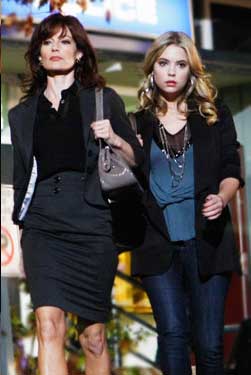

Pretty Little Liars isn't a perfect television show, but it's more than adequate as  both an engaging drama and commentary on pop culture and the socialization of teenage girls in the US. It presents a realistic situation for many teen girls wrapped in the ostensibly ridiculous premise of a friend's murder: that a person's entire world is watching them, waiting for them to screw up, itching to take them down or shame them in any way possible, gossip about them, be cruel to them or force them to be cruel to others, present them with an array of impossible choices. That is teenagehood for many girls--a claustrophobic atmosphere of nerves, indecision, judgment, and fear. At worst, PLL normalizes bad behavior--shoplifting, lying, blackmail, bullying (an accusation lobbed at many teen shows and one I don't have much time for); at best it invites discussion about those behaviors and their roots through the exaggeration and heightened stakes of the Liars' world.

Friday, December 07, 2012

The Kamelot Superpost, Part 3: Iconography of Kamelot

Karma, Epica, and The Black Halo form the core of Kamelot's catalogue, with The Black Halo still being hailed as one of the greatest power metal records in the history of the genre. It was with these three albums that Kamelot really came into their own and refined their sound, placing themselves at the front of the European power metal scene. Thematically, Karma followed in the pattern of The Fourth Legacy with fantasy and myth-inspired lyrics on many tracks (particularly the record's three-part epic "Elizabeth," about the legendary Elizabeth Bathory), but also branched out with two of the band's most popular love songs, "Forever" and "Temples of Gold," as well as the deeply personal ballad "Don't You Cry," written about guitarist Thomas Youngblood's father. The telltale themes of love and loss are strongly present on Karma; all three ballads are concerned with the loss of a loved one, whether it be romantic or familial love. The title track and "Elizabeth" encapsulate another of Kamelot's favorite themes: the lines between holiness and profanity, physical desire and spiritual longing. This theme would be expanded upon between Epica and The Black Halo, but on Karma it takes the shape of reflections on power, creating one's own immortality--and thus sidestepping God--and desire to escape mundane ties or the corporeal form and its strictures, and ascend to something greater. Both a heavily mystical album, between the monster-themed "The Spell" and the blood magic of "Elizabeth," and a personal one with "Don't You Cry," Karma blew open the doors to gorgeous, powerful metal, refining what The Fourth Legacy had begun.

(album cover from Prog Archives)

Epica and The Black Halo form a diptych of concept albums centered around a loose interpretation of Goethe's epic Faust, with Khan and guest singers, including Shagrath of Dimmu Borgir and Simone Simons of Epica (yes, they named their band after Kamelot's album), taking on specific personae in order to tell the story through song. These core characters are listed below:
  • Ariel (sung by Khan)
  • Helena (sung by Mari Youngblood)
  • Marguerite (sung by Simone Simons)
  • Mephisto (sung by Khan on Epica and Shagrath on The Black Halo)
"Center of the Universe" and "The Edge of Paradise" present a pairing tied together by the theme of egoism--a trenchant topic in both Conception and Kamelot's music, which in this case deals with the (possibly vainglorious) soul-searching of Ariel and encapsulates the crux of his quest: he will forsake earthly treasures, including the love of his life, Helena (and even God, as seen in the song "Farewell"), in pursuit of higher spiritual knowledge. At the outset, Ariel's journey is the fruit of his own vanity; however, eventually he is tempted by Mephisto and falls prey to the demon's wiles and promises. Sacred and profane desires intermingle in "On the Coldest Winter Night" when Ariel encounters Helena once more, and this is where the core themes of the album emerge. Though in love with Helena enough to spend the night--and a few weeks after--with her, Ariel then shelves her in order to continue his quest. Despite his ostensibly pure intentions of shielding her from Mephisto's evil, his actions result in Helena's suicide and the death of the child she carries. Once Ariel discovers this (in the depressingly named "The Mourning After"...way harsh, Tai), his journey takes on a new dimension of redeeming himself for causing her death. It's also implied that Helena, in Heaven with her child, has become the symbol of what Ariel is searching for, though he won't become aware of that until The Black Halo. Helena serves as Ariel's moral centerpoint throughout the story, alive and dead, an icon of purity, goodness, and clarity; whether this is fair to her or not is debatable. Ultimately Epica finds Ariel alone and wrecked by his desires--though not necessarily his physical ones. The narrative doesn't indict Ariel for his love, but rather for placing his desire for otherworldly knowledge above the very real, earthly factors of Helena and their child.

Musically, Epica finds Kamelot riding the rising wave of Karma, delving into a more symphonic sound with expanded keyboard sections, female vocals, and choir backing suitable for themes of salvation and damnation. The record also utilizes "interlude" segments that are reminiscent of film soundtracks--Poetry for the Poisoned would perfect this trick--and act as transitions between major plot occurrences, such as Ariel meeting and leaving Helena. Rifftastic guitar lines abound, and the album's atmosphere runs from the pure power metal glory of "Center of the Universe" to the haunting ballad "Wander" to the operatic prog of "III Ways to Epica."

(album cover from Prog Archives)

The Black Halo, Kamelot's magnum opus, is the concluding half of the Goethe story and picks up with Mephisto's ongoing seduction of Ariel via a woman named Marguerite, who bears an uncanny resemblance to the dead Helena. An area where Kamelot steps outside the bounds of their fellow power metallers somewhat is in terms of erotism--Rhapsody of Fire, for instance, is apparently adhering to a strict no-sex policy, lyrically speaking. Kamelot imbues many of their songs, particularly on The Black Halo, with oblique nuggets such as "how could that first time recur" and "I see her shame in my desire." "When the Lights Are Down" is a lengthy metaphor for sex cloaked in a veil of loneliness and betrayal, while "The Haunting" and "This Pain" drive the point home. The album's simultaneous concern with carnal passion and sacred wisdom can be interpreted in a few ways: first, there is the ever-present influence of chaste courtly love narratives, in which the male voice speaks of and longs for his lady love from afar but may or may not actually consummate things; second, there is the possibility of Ariel's romantic/physical desire being ultimately the same drive as his lust for spiritual knowledge and higher wisdom. I think the latter point is more likely, given that in "Memento Mori" Ariel dies, ascends to Heaven, and finds Helena waiting for him--she has become the embodiment of his salvation and his reward all in one. However, these two angles may be synthesized as well, since aspects of courtly love infuse all of Kamelot's albums from Siege Perilous up through Ghost Opera, mingling seamlessly with their ongoing themes of personal search and development.

Though like its companion album The Black Halo is derived from Faust, for my money it also evokes another of Kamelot's favorite literary sources: Arthurian legends. Specifically, Ariel's interactions with Marguerite call to mind Lancelot's relationships with Guenever and Elaine--to be brief, Lancelot is tricked into sleeping with Elaine under the belief that she is Guenever (in his defense, he's super drunk). White emphasizes that the triangle between Lancelot, Guenever, and Arthur is actually a quadrangle, with God being the fourth partner, as Lancelot vacillates between trying to be a good Christian and a good lover to Gwen. This is eminently relevant to The Black Halo, witnessed when Ariel is seduced into sex with Marguerite while believing she is Helena returned from the dead, and echoes the themes of Epica, which show him torn between his love for Helena and his obsession with obtaining arcane knowledge. It's possible that something of Khan's private life came into play in creating these two albums as well; both have a personal vibe unique from more typical fantasy-derived power metal lyrics (in this interview Khan talks about how his personal life inspired many of his lyrics). Regardless of where exactly the core inspirations for The Black Halo came from, the band capitalized on the tensions arising from soul-searching, epic quests, and heartache to create a record both mythological in scope and human in perspective.

(album cover from Prog Archives)
 
The production on The Black Halo is flawless, showing off every aspect of Kamelot's arsenal, from Khan's pipes to Palotai's keyboards. The guest vocalists and musicians add even more layers to increasingly complex music, and the array of songs displays a band capable of switching from passionate ballads such as "Abandoned" to the riff-heavy "Moonlight" and the intricate "Memento Mori," one of Kamelot's longest single-part songs. Taken together, Epica and The Black Halo are Kamelot's most iconic albums, and the albums most indicative of their distinctive sound and songwriting prowess: essential, textbook Kamelot.

Necessary Tracks: "Temples of Gold" from Karma, "III Ways to Epica" from Epica, and "Memento Mori" (live) from The Black Halo.

Tuesday, December 04, 2012

The Kamelot Superpost, Part 2: Finding Focus

In 1997, former Conception vocalist Roy Khan joined Kamelot; the following year the band released Siege Perilous, their third album and the first to feature Khan on vocals and Casey Grillo on drums. Another record oft-overlooked by fans, Siege Perilous is a bit more well-regarded by people who don't consider themselves Kamelot devotees (one Encylcopedia Metallum review refers to the genre as "flower-metal" but gives this album a good review. So there you have it!); it's a bit rougher and murkier than what was in the cards, with Khan still finding his footing, but a bad album it is not. Both lyrically and musically, Siege Perilous is firmly within the boundaries of power metal: operatic vocals, fantasy-themed lyrics, and speedy guitars. Arthurian mythology appeared for the first, but definitely not last, time on a Kamelot record with the title itself, referencing a particular seat at the Round Table; other fantastic elements found in the lyrics include references to the fantasy roleplaying world RhyDin and questing/adventure plots typical of power metal, such as "King's Eyes" and "Expedition." At this point, Khan had not yet joined with Youngblood for full lyric-writing duties, and penned only three songs on Siege Perilous. However, these three were indicative of the themes and motifs that would arise in his writing going forward; "Millennium" and "Parting Visions" (the former containing a familiar phrase for close listeners who happen to be Conception fans, AKA me) focus on personal quests, the hunt for truth, and struggles between earthly knowledge and heavenly wisdom, while "Irea" sets a template for songs mourning a lost love. Perhaps most significantly, "Irea" places the hope of the narrator's salvation on the shoulders of the woman he loves, a situation which pops up continuously in Khan and Youngblood's lyrics.

  (album covers from Prog Archives)


The Fourth Legacy, released in 2000, was the first record to really put Kamelot on the map as an international power metal force to be reckoned with. With glossier production than previous albums (the band themselves produced Siege Perilous), outright joyful guitar work, and plenty of Khan's operatic pipes, this fourth album remains the most typically power metal Kamelot gets--and it also laid the groundwork for what was to come. Not to say that what followed was formulaic in any way, but the big hooks, impressive vocals, emotive ballads, and connective, coherent lyrics found on The Fourth Legacy formed a foundation Kamelot continued to build and expand on. Overall, The Fourth Legacy showcased a band that was hitting its stride, molding a unique sound, and shaping its personal mythology. Featuring several soaring anthems worthy of being staples on every power metal fist-pumpers playlist (including the title track and "Until Kingdom Come"), lyrically the album mines familiar thematic territory: kings and crowns, mystical female figures, mythic-historical settings--this time with "Desert Reign," "Knights of Arabia," and "Alexandria," all featuring desert-flavored keyboard work--and the Arthurian tune "The Shadow of Uther." 

"Silent Goddess," "Until Kingdom Come," and "The Inquistor" in particular spell out some of what would become Kamelot's narrative signatures: faceless women who hold the narrator's life and soul in their hands, and a servant of God who's more akin to the Devil. The voice of the cleric in "The Inquisitor" is similar to the voice of Mephisto on Epica and The Black Halo--a taunting allure that promises wisdom and everlasting life, through means not so different as they should be. Meanwhile, the women of "Silent Goddess" and "Until Kingdom Come" foreshadow the saga of Helena; cast in terms of destiny and pleas to elevate the narrator's soul, these figures are never glimpsed up-close, never speak themselves. Instead they, along with the woman in "A Sailorman's Hymn," function as beacons for the questing soul. Various aspects of courtly romance can be found in these tracks, from the princesse lointaine embodied by all three (particularly the silent goddess) to the possibility that the narrator subscribes to a chivalric code, which will ultimately test his loyalty to his lady. This lyrical ambivalence would be played up and ultimately resolved as Kamelot's career moved forward.

Necessary Tracks: "Where I Reign" from Siege Perilous (note: this link goes to the full album on Youtube; "Where I Reign" is the fifth track) and "Until Kingdom Come" from The Fourth Legacy.

Sunday, December 02, 2012

Stick a fork in me, I'm done

I don't know how the makers of Pretty Little Liars manage to actually lace their show with crack, but

it's a problem.


A glorious problem.

Friday, November 30, 2012

The Kamelot Superpost, Part 1: Introduction and Early Years

Yes, it's that time again...SUPERPOST AHOY. This time around I aim to inquire into the mythical, literary, and courtly-romantic elements that inspire many power metal bands' lyrics, with specific emphasis on the power metal band I'm most familiar with: Kamelot. The post series will take the shape of this introductory post, a post for Roy Khan's first two ventures with the band (Siege Perilous and The Fourth Legacy), a classic Kamelot post (Karma, Epica, and The Black Halo), a Kamelot-branches-out post (Ghost Opera and Poetry for the Poisoned) and a speculative post concerned with Tommy Karevik, Silverthorn, and the band's future. As ever, if this is not your bag, apologies and ignore at will. I'll try to intersperse these with other things of interest.

Starting off, a few relevant details: Kamelot was founded in Tampa, Florida (HAAAAAY) in 1991. The lineup originally consisted of Mark Vanderbilt on vocals, Thomas Youngblood on guitar, Richard Warner on drums, and Sean Tibbets on bass; David Pavlicko played keyboards for a time as well. After releasing two albums, Eternity and Dominion, Vanderbilt and Warner left and were replaced by Roy Khan and Casey Grillo respectively, while Glenn Barry took over for bass on Dominion and remained with the band until Poetry for the Poisoned. These first two albums are often ignored by fans for being subpar to what would come during Khan's reign, but both are solid power metal records and deserve some consideration. Both featured lyrics by drummer Warner and music chiefly from Youngblood, with some involvement from Barry and Warner, and both albums illustrate the fantasy bent of many power metal songs. Lyrically, these records delve into mythology and history, often with a medieval setting--songs such as "Gleeman," "Song of Roland," and "Birth of a Hero" are good examples of these tendencies, which are found throughout power metal, beginning chiefly with the mighty Blind Guardian. Battles are fought, crusades embarked upon, demons encountered, and the only inklings of what would become Kamelot's chief lyrical themes are "Sin" and "Crossing Two Rivers." These songs, both from Dominion, emphasize fruitless love and loss as well as the relationship between bodily and spiritual desire, topics which would come up repeatedly on future albums.

     (both album covers from Prog Archives)

In terms of lyrical content, the fantasy and mythic-historical base of the band's songs was obvious even at the beginning of their career. Courtly love stories and poems range from sensual to highly spiritual and even platonic, often positioning the female object of desire as a noble, nigh-sacrosanct figure: the princess in the tower. To what extent Kamelot utilizes these concepts, along with popular myths such as those of King Arthur, and classic literature, specifically Goethe's Faust, will be examined in later posts. It wasn't until Khan arrived and merged his vast song-writing talents with those of Youngblood that what I consider Kamelot's classic sound and themes really began to emerge...but that's a song for another day. Arguably Kamelot is one of the best examples of seamless fusion between three of the major forefathers of European power metal; Blind Guardian, Helloween (as well as Gamma Ray), and Stratovarius each pioneered the genre in notable ways, with every band following acknowledging these groups in some fashion, whether to pay homage or to diverge. Though Kamelot is an American band and one of the early US power metal groups, their most iconic work is in the European vein--yet their later work has opened up into gothic and even doom metal territory. This hybridization makes them one of the most interesting power metal bands to analyze.

Necessary Tracks: "Call of the Sea" from Eternity and "We Are Not Separate" from Dominion. Unrelated to anything else but amusing to me, these album covers kicked off a trend of purple that wouldn't be broken until The Black Halo.

Monday, November 19, 2012

The place that cradled me is burning

Normally I am not much for Gawker, but one of my favorite Hairpin writer/commenters, Mallory Ortberg, has begun doing pieces for them, so occasionally I have to venture in (the Gawker commenters, may I say, do not deserve melis even a little bit). Last week she wrote an article entitled "Have You Heard the One About the Religious Woman Who Stops Being Religious In College?"

Obviously that was going to be totally all up in my alleys, and it was--not just the memory of having religion and losing it, or the experience of being let down by authority figures and God, or the tendency to keep the church in the corner of my eye, whether incidentally or intentionally, or the lingering guilt over choosing to read the same SWEU novel for the eighteenth time instead of doing my scripture study. When I was young there was a disconnect between my home life and my church life; people said things from the pulpit and in Sunday school that my mother would never have said. When we were small she let us wear two-piece bathing suits, of all things, and didn't hover over my shoulder when I checked out books with swear words from the library. As I grew older and after my mother remarried a very stringently devout man, the gap closed, church authority and family authority presenting a united front (as I suppose it should have been all along, ideally). I have no idea if I still would have left had my mother continued to be relatively personally liberal, showing me that there was a way to be a good, faithful LDS woman as well as keeping one's own counsel.

This brings me to the crux of Ortberg's piece, what really hit home: the idea, totally foreign to me at age nineteen, that change can happen from within. It honestly never occurred to me to wonder if I, I, could be an instrument of change in the LDS church. That simply wasn't how the church worked. I only knew that I had become aware of the church as a place I could no longer belong. I didn't think about what it would need to be like for me to continue belonging there. Maybe it's no better than saying if my aunt was male she would be my uncle, but as a blogger who reads a good many LDS and ex/post/whatever-LDS blogs, I am seeing inklings of change. I see the women of fMh, I see Joanna Brooks. They're doing something I didn't think could be done. I'm still not sure it can be, or if it's worth it. But it's happening and I am watching, occasionally befuddled, more often proud.

Sunday, November 18, 2012

but yes, it's good

On Friday at work, I was reading Maggie Stiefvater's newest novel, The Raven Boys, during lunch. A coworker asked me if it was good. 

Dear coworker, whether this book is "good" or not has very little to do with my enjoyment of it. See, Stiefvater and I are roughly the same age, and--based on what I know of her reading habits from interviews and the like--we read many of the same books when we were teenagers. The Raven Boys is basically the book I would write if I had the skill. It is a book which seems to have arisen out of formative-years obsession with Welsh mythology, implanted by authors like Susan Cooper and Lloyd Alexander. Like Walton's Among Others, my reaction to The Raven Boys was about the memories and emotions it evoked in me. I was a child obsessed with Wales and stories about King Arthur and other murky rulers of Britain's past who grew up to be an adult interested in magic at large and most specifically how magic is utilized in my day, in people's everyday lives, in "modern" America. 

The Raven Boys has that. It has ley lines, the Old Ways found in the Dark Is Rising books, the magical tracks I read of in New Agey books about Stonehenge when I was fifteen; it has Owain Glyndwr, the fabled icon of Welsh resistance to English tyranny; it has, obviously, raven boys, some of whom are very Bran-like indeed. It has psychics and rituals and mirrors, sacred groves and visions (no, not that kind), theories of Welsh expeditions to the Americas predating Columbus. It has inklings of authors that came before, Monmouth and Malory. It has people for whom magic is the everyday, a trope I find endlessly appealing (and why I think the term "magical realism" is a good one and serves a purpose). It is in itself a mirror, reflecting a mass of my reading experience, the books that really shaped me, back to me.

Perhaps best of all, it serves as a bridge between those books, which some readers may not have read, and the shining new fairy tale Stiefvater has created. It is possible to enjoy The Raven Boys without knowing a thing about Welsh history and myths, and I suspect that this book will serve many readers as a tease to know more. Never a bad thing. It's good to know there will be more books in this new series--three more--especially after that damn ending.

Tuesday, November 13, 2012

To strive, to seek, to find, and not to yield

I saw Skyfall last night. Sam Mendes managed to do something lovely and tricky with this movie: he made a Bond film that is both homage and deconstruction. Over the course of two and a half hours, Daniel Craig, Naomie Harris, Ralph Fiennes, Ben Whishaw, Javier Bardem, and Judi Dench examine what it means to be James Bond in the 21st century--where "James Bond" is a metonym for Great Britain itself. This goal appears as a running theme of old Britain and new meeting, occasionally clashing, as when MI6 is forced to relocate to a WWII bunker, M quotes Tennyson to MPs, and Bond and Q meet up in front of The Fighting Temeraire (yes, I squealed). Bond's own past becomes the contingency plan as he and M travel to Skyfall, his ancestral home in Scotland, to outsmart Silva (Javier Bardem as one of the most effective Bond villains in some time), pulling a Home Alone-style series of boobytraps that somehow fit seamlessly with the helicopters and motorcycle chase scenes elsewhere in the film. There's a glimmer of self-awareness, of acknowledgment between Bond and M of how she has taken advantage of him for Queen and country, and how he will continue to allow himself to be weaponized. Skyfall also references the history of Bond movies--an ejection seat in the Aston Martin, Q's quip about exploding pens, the return of Moneypenny and the positioning of M as the film's chief Bond Girl--while settling the story and characters firmly in their own time with a cyberterrorist plot and high-tech guns.


The question posed by Skyfall is whether Bond (and by extension MI6 as it is run by M, and further the United Kingdom as a political entity) is still the go-to in terms of national security. Is he fit, active, flexible, deadly? Is he still capable of competing? Or is he the warship hauled in for breakdown? As far as this query goes, the film is a success, reassuring everyone that the British stiff upper lip will prevail when backed up by big guns; in other realms, it's a bit more opaque. The devastating and underutilized Berenice Marlohe, whose character is a former sex worker indentured to Silva, is killed off with possibly even less fanfare than Caterina Murino in Casino Royale, and M dies as well, to be replaced by...Ralph Fiennes, not Helen McCrory for reasons I cannot fathom. Because there must always be a Moneypenny at the desk, Naomie Harris quits the fieldwork and starts shuffling papers--truly  I am torn in this regard, because as Moneypenny, there's a good bet that Harris will show up in at least one more film, but her sparkle and wit and savvy could be used to such greater effect. Then there's Silva himself, a perhaps queer man with vast mommy issues as the film's villain; Bardem is good enough an actor to bring some of the hallowed Bond-villain camp, but it sometimes skates close to Evil Gay ground (though it isn't clear if Silva is actually gay or bisexual, or if he is just willing to use every tool at his disposal, and at any rate, Bond is unmoved by Silva's advances--which may be the entire point). As the inverse of Bond, Silva, his machinations, and his relationships are intriguing, to the point where it becomes difficult to discern if Mendes has given us a straightfaced Bond movie or is trying to tell us something about the way he views the genre (and it is a genre by now). Everything about Silva is taken to the limit: he uses women literally to the point of death, he plays with bottles of fine Scotch as props, he wields sex as a weapon. So what does that say about James Bond?

Friday, November 09, 2012

Two head-bangers and a head-tripper

Only a new book from an author I love is better than a new CD from a favorite band...and October saw three new releases from some of my faves! Though The Haunted Man and Apocryphon have been out since October 22, I've been sitting on thoughts about those two so I could put all my new music feels into one big post once Silverthorn arrived. And it finally did, and oh, was it worth the wait? Yes, it was. More on that in a moment; Bat for Lashes comes first. 

Now it had been three years since the release of Two Suns, and like most other fans I was on pins and needles for The Haunted Man. It doesn't disappoint--perhaps less mystical than its predecessors and more stripped down, Bat for Lashes' third record is as charming, strange, intimate, and charismatic as a devotee could hope. The first single, "Laura," is a heartfelt tale of doomed stardom, while "Lilies" is a track bursting with vitality (and one I can't wait to add to my springtime playlist) and "Marilyn"'s eerie background chatter harks back to "Bat's Mouth" from Fur and Gold. Like a Bat for Lashes album should be, The Haunted Man is a subtly demanding listening experience, not background music by any stretch, and a raw, rewarding album for old and new fans alike.

First Favorite: "Winter Fields." It's not overstating things to say that I am obsessed with this song, especially now as winter approaches the Cleve. According to iTunes, I have listened to the entire album four times and "Winter Fields" thirteen times since obtaining it on October 29th. Oops?


The Sword's latest release, Apocryphon, is a similarly powerful effort, one which combines the flavors of Age of Winters, Gods of the Earth, and Warp Riders to great effect. Mythology, references to science fiction, and riffs on fantasy tropes are all present, making for a melting pot of speculative, introspective storytelling via crunchy guitars and thrumming bass. The record features no instrumental tracks, a first for The Sword, and is perhaps less "finished" sounding than Warp Riders--but for a group like this, who are most fundamentally a live act, that isn't a bad thing. A few new elements appear on Apocryphon, most notably some trippy synth on "Dying Earth," and "Eyes of the Stormwitch" and "The Hidden Masters" have a pleasantly Western-twangy tinge...fitting, as the band hails from Texas. The Sword's original drummer, Trivett Wingo, left during the Warp Riders tour due to exhaustion and anxiety issues, and new rhythm fanatic Jimmy Vela III is shutting it down--I especially enjoy the feisty drum work on "Hawks and Serpents." I'm really looking forward to hearing this new material performed when The Sword come to rock Cleveland this evening!

First Favorite: I loved "Eyes of the Stormwitch" before I even heard it (who can resist that title?) and even more now that I've had it on repeat. PS: if you'd like to know more about the album artwork, check out my related post on Between the Panels.

Kamelot, as mentioned here previously, has recently gone through a lineup change, and Silverthorn is new singer Tommy Karevik's album debut with the band. This record had been teased as a "return to form," and indeed, compared to the proggy, doomy Poetry for the Poisoned, Silverthorn has more in common with earlier albums such as Epica. Karevik's vocals are part of this; as Khan's voice aged a bit, it took on a grittier edge than had been present during his fresh-out-of-opera-school days--which was appealing and added new layers to the music (for my money)--and the choirboy cleanness of Karevik's voice fits well with the symphonic musicianship and goth undertones of the new album. Silverthorn is nothing if not a production, in every sense: impeccable sound-mixing, extravagant instrumental pieces, guest vocals galore (including my favorite death metal queen Alissa White-Gluz, Elize Ryd, and Sascha Paeth), and a concept that extends to a full-color story booklet that came with the limited edition CD. As with any new album, particularly one showcasing a new vocal talent, it'll take a few listens before Silverthorn sinks into my brain, but it's certainly living up to the hype.

First Favorite: Like everyone else with ears, "Veritas" is my most-listened track off Silverthorn so far...especially after seeing this.

Wednesday, November 07, 2012

Forward

Like most of America, I imagine, last night I sat up glued to my computer screen, downing far more local porter than advisable and scarfing pizza to stave off the anxiety that Mitt Romney might become the leader of my country. Fortunately, thanks to stubborn voters standing in lines for five hours or whatever gods might be smiling on us, Barack Obama retained his office with 303 electoral votes--including those of my new state, Ohio (yes, I cried tears of pride when those results rolled in--now if only Florida will match it!).


Beyond this happy news, the 2012 election also yielded a Senate majority for Democrats (let's hope they use it), and better yet, ousted or denied several members of the rightwing rape-enabling brigade: Elizabeth Warren defeated Scott Brown in Massachusetts and Claire McCaskill won against Todd Akin in Missouri. That the winners were female senators is just icing on the cake. Tammy Baldwin of Wisconsin took Tommy Thompson's seat, to become the first openly lesbian senator in US history, and Tammy Duckworth will replace Joe Walsh (another rape-enabler) and become the first US senator with a disability. Anti-marriage amendments were struck down in four states and Massachusetts legalized medical marijuana, while Colorado and Washington legalized it for recreational use, with limits.

All in all, it was a pretty good night. President Obama isn't perfect--he certainly isn't as wildly progressive as some reactionary types like to imagine--but waking up this morning to four more years was a good feeling. It is good to think that there are voices in this country that outlast the lunatic fringes and that voting shenanigans can't always keep democracy down. Now we have four more years to get the things done that matter, four more years to work for education initiatives, healthcare, and true civil rights for all our citizens, four more years to work on ending our various fruitless wars. We elected many great people yesterday: now we have to hold them accountable.

Wednesday, October 31, 2012

The continuing travails of a Star Wars fan

As you may have heard yesterday, Lucasfilm is being sold to Disney for $4 billion. George Lucas will be a "creative consultant" but otherwise plans to retire.

Now.

After the initial shock, I have decided that this may not be the end of the world. My only real side-eye goes to Disney's apparent plan to release a new Star Wars film "every two to three years" because really? Really? I feel like that may be reconsidered once the new projects get off the ground. However, all told, I like Disney (with caveats) and the thought of someone besides Lucas making films for my favorite franchise is not a bad thing. I do have many questions: will Marvel start publishing Star Wars comics now, rather than Dark Horse? Will someone try to shoehorn Harrison Ford, Curmudgeon Extraordinaire into playing Han Solo one more time? Will Disney World finally get an all-SW theme park? Will the first three new films utilize Expanded Universe canon or will they be totally original efforts? Most importantly, will there be Mara Jade??

That last query leads me to the real point of this post. As I see it, the Star Wars franchise coming under Disney's control opens up the universe to...really anyone whom Disney sees fit to write or direct a movie. Some of Disney's live-action films have been really great (The Princess Diaries, Remember the Titans, The Lion, the Witch, and the Wardrobe, The Muppets, and of course The Avengers come to mind), and I would love to see something stellar come out under the Star Wars banner. Given the wealth of sudden new directions and opportunities for Star Wars, what would I want from a new Star Wars movie? Well--it's not like it would ever happen, but I'd kill for a Mara Jade movie set before the events of the Zahn novels, a nice pulpy shoot-out directed by Tarantino and starring Bridget Regan that sneakily calls to events taking place in the Empire as Mara serves as the Emperor's Hand, but never quite Goes There. A hack/slash Rodriguez flick about the Nightsisters would be fun. A taut political thriller by Bigelow about the second Galactic Civil War would not be unwelcome. And I'd watch a creepy, beautiful travelogue of the known universe directed by del Toro in a heartbeat.

Probably none of these will happen. Probably Disney will hand the reins to one of the directors that immediately came to my mind as people I didn't want around the SW franchise (Abrams, Whedon, Jackson, or--heaven forfend--Bay). But that is the chief blessing and curse of the Star Wars fan: there is always room to hope. Right now, my hopes are high. Please don't dash them too badly, Disney.


Monday, October 29, 2012

NOPE WRONG GET OUT

A few days ago the image below went up on a Kamelot fan confessions Tumblr.


Now. Let me count all the ways this gave me flames on the sides of my face! 

1. Complaints like this specifically target female fans. When a statement along these lines is made, no matter what fandom it's for, the person making it is not usually thinking of tons of gay men who suddenly love Hawkeye because Jeremy Renner is hot. They're talking about frivolous female fans who are apparently only interested in looks, not content. Complaints in this mode are inherently sexist; someone assuming I only enjoy Kamelot because of the hotness of the lead singer is the spiritual sibling of the dickbag that makes me prove my nerd street cred by listing my favorite comic book artists.

2. Complaints like this almost never have any basis in fact. If Kamelot's music had taken a sudden downturn or become otherwise radically different after gaining Tommy Karevik as a lead singer, fans might have a reason to look askance. But it didn't; I haven't heard all of the new album yet, but it's by all accounts more like certain older albums, which should please longtime fans, and it's doing exceedingly well on metal charts. If there is an influx of new fans, it's more likely due to a new album getting lots of positive reviews and the band touring with Nightwish, a gigantic name in European metal.

3. Complaints like this ignore the fact that Roy Khan is fine as hell. If you are going to be the kind of asshole who makes remarks like this, you better remember that Kamelot's previous lead singer is also exceptionally attractive. Neither Khan nor Karevik's looks have any bearing on their musical talent, which in both cases is extensive.

4. Complaints like this ignore the fact that Kamelot has always had a sizable female fanbase. Why's that? For one thing, women enjoy good music! Wow, right? Brand new information! For another, neither the band members nor the music have ever been overtly misogynist or gross toward women. Always a plus. The culture around power metal is more welcoming than some other subgenres, and I personally have never felt threatened or unwelcome at Kamelot shows (though as in all things, YMMV). These factors combine to make a great atmosphere for all fans, including women. Female Kamelot fans are in no way new or news.


In short, keep your jerkery out of my fandom. One of the best things about being a Kamelot fan is that the fanbase is usually very levelheaded and not assy about non-issues like this. A more drama-free fandom I have yet to meet. I don't like seeing shit like this floating around, and I don't enjoy people creating issues where there simply aren't any.

Friday, October 26, 2012

Spellbound

As you may know, I was born and raised in Florida, and lived there until almost a year ago; now I'm in Ohio, where there are Seasons...like autumn. Real actual autumn. I have slowly been going insane with the weather since September: looking up scarf-tying tutorials, mulling mead, baking tiny pumpkin-shaped pies, standing under trees and photographing their leaves, etc. 

And as the days have edged up closer to Halloween, I have been wanting to dress up like a witch, all the time. Witch-chic or bust. However, in lieu of spending my paychecks on velvet skirts and pointy ankle boots, I mostly just make Polyvore sets. 


curse the night


the power of Manon

everyday witchcraft


Echo Bazaar


Are any of you as addicted to autumn and/or Polyvore as I am?

Wednesday, October 17, 2012

Why be serious when you can make stupid jokes?

I suppose I could write something about the Romney campaign, how Romney has figured in news media and how Mormonism has, and my general ire that such a man is a serious candidate for presidency, but I would rather recount an amusing portion of a popular LDS book.

Everyone has heard of The Work and the Glory, right? If not, all you need to know is that it's a sprawling nine-book epic of historical fiction centering around the development of the LDS church. The storylines range from the earliest inklings of Joseph Smith in New York to the arrival of the Saints in Utah; most of the notable figures from LDS history factor into the plot, which is about the fictional Steed clan as members of the church. Obviously I read these ravenously when I was a teenager, and I suspect that if I read them now, they would likely hold up reasonably well as literature, despite the first six being practically hagiography of Joseph Smith.

ANYWAY. At some point--I think in Season of Joy?--one of the characters, an Irish girl named Kathryn, is struck by lightning. During her recovery, English boy (and later husband) Peter reads to her. One of the things he reads is Robert Browning's play-poem hybrid Pippa Passes. Now Pippa Passes is most famous for its line "God's in his Heaven, all's right with the world!"--an extensively quoted piece of literature--and Peter mentions this line before reading it to Kathryn. However, Pippa Passes also contains one of the greatest authorial misunderstandings in the Western canon: the inclusion of the word "twat" where a twat has no business being (the line in question is "owls and bats, cowls and twats/monks and nuns in a cloister's moods/adjourn to the oak-stump pantry").

Twat.

TWAT.

So yeah, just imagine good little Mormon boy Peter reading the word "twat" to his good little Mormon girl future-wife Kathryn. I have no idea when the cultural ban on swear words occurred in the LDS church, but I do know that "twat" was a dirty word back then as it is now, and it's amusing to consider a gently-bred young woman like Kathryn being like...what did you just say? I have no idea if Lund was aware of this line. Either way it's funny, because I have a twelve-year-old's sense of humor.


Also, mostly unrelated, but I'm a little bit amazed that there is no filthy fanfic for The Work and the Glory. Get on it, writers! So many slash opportunities! So many husband options for Jessica! Lydia hooking up with Joshua on the side! Polygamy! Sorry I'm not sorry.

Friday, September 28, 2012

Lazy round-up

Between a surprising and distasteful item sent in the mail from my mother and a general long week at work, I'm really fucking glad it's Friday and in no mood to talk about Serious Things, or even really anything cohesive--so have a few links to things I've done around the web recently, and things I'm currently enjoying.

  • I've been emblogginating over at Paper Droids, in the Style section if you can believe it, with some outfits inspired by heroines from all sorts of nerd media. The newest is Jade from Beyond Good and Evil.
  • I've also been writing reviews of comic books for Between the Panels, and last week joined site runner William Goodman, Esq. and dandy Tumblrpeep Justin Partridge for talk about Avengers vs. X-Men, Batman, and Fantastic Four. Warning: the first time you hear my voice, I say something mean.
  • Have you registered to vote? There's still time!
  • Elementary aired last night and yes, I love it. Partially out of spite, partially because it actually seems like it will be fun, but mostly because Lucy Liu is flawless.
  • Grumpy Cat is my Patronus.
  • Seriously, Tommy Karevik can wail. I'm very much looking forward to their headliner tour next year. 
  • Mark Reads has reached In the Hand of the Goddess and oh my zombie Jesus, this liveblog is just so excellent and will keep on getting better, because HE IS NOT PREPARED FOR TORTALL.

Saturday, September 22, 2012

If there's something better than seeing Nightwish live, it's seeing Kamelot open for Nightwish.

A few reasons I enjoy power metal shows:


1. The musicians are good. Perhaps because the style of music generally calls for virtuosic vocals and instrumentals? All I know is I've never been to a shitty power metal concert, period, and some of them have been close to religious experiences. Both Kamelot and Nightwish whipped it out last night, happy to report; apparently since the last time I saw Nightwish they've boomed in the US, because the venue was packed, sold out to about 1500 people--and let's be real, in Europe these bands regularly sell out to twice that. I'm torn between being proud that the line to get in stretched across five blocks of downtown Columbus and somewhat fearful that bands I really love might graduate to stadiums someday soon. I dislike stadium concerts as a rule.


2. The fans are polite. I kinda hate moshing, and thankfully power metal fans generally groove politely. Last night's show was the first time (out of seven similar concert experiences since 2006) that I've ever seen even a bit of crowdsurfing at a power metal show. There are always huge singalongs, which the bands tend to encourage. In my experience there is also usually less douchebaggery at concerts for these bands, though I have no theory on why that might be aside from a reasonably even male/female fan ratio.


A few music notes: Nightwish is touring their newest album, Imaginaerum, which made for a nice blend of songs from that record and stuff from Dark Passion Play and Once. I would have been happy no matter what their setlist was, because the band puts on a great show (and have very adorable camaraderie), but I was so happy to hear "Dark Chest of Wonders," "The Islander," "7 Days to the Wolves," and "Slow Love Slow" (a jazzy, generally unmetallic number from Imaginaerum which I adore). Kamelot's set was also pretty nice, pulling chiefly from Ghost Opera and The Black Halo plus the performance of the first single, "Sacrimony," from their upcoming album Silverthorn. This tour is most notable for it being the first official tour with new vocalist Tommy Karevik. As a fan of some years and a Khan devotee, I was anxious to see Karevik in action...and he did not disappoint. He has a great grasp on the band's older material and I'm really looking forward to hearing them perform the new album when they inevitably headline the Silverthorn tour (she said, sacrificing a goat to that end). A very talented performer and a great new frontman for Kamelot.

Other highlights included guest vocals from Elize Ryd and Alissa White-Gluz on a few Kamelot tracks, gorgeous instrumental back-up from Nightwish's touring musician-of-all trades, Troy Donockley, and getting to commune with every European metal fan within four hundred miles of Columbus.

Friday, September 07, 2012

ALERT ALERT

Mark is reading The Song of the Lioness! He's only on chapter three, so you have plenty of time to catch up. If you're not familiar with Mark Does Stuff, basically the dude in question reads and watches things that people love, and liveblogs his experiences. If you love a thing he is watching/reading, it can be very fun and rewarding to observe him flipping out over, say, all of His Dark Materials.

Yeah, that one was fun.

And now we get to watch him discover Tortall. A WINNER IS ALL OF US.

Wednesday, September 05, 2012

Last LDS-related post for awhile and I swear there'll be kittens or sex or something FUN soon

In the interest of providing some background and insights into people who manage to be both Christian and polytheist or other brands of pagan, a few links:

Ruby Sara's new blog at Witches and Pagans 
Cat Chapin-Bishop and Peter Bishop, two Quaker Pagans 
Zillah Threadgoode of Surprised Christo-Pagan 

And one that is specifically LDS: Mother Wheel

Not all of these bloggers' paths fit my personal definition of what "Christian" means, but they all share glimpses of spirituality that reaches beyond what we typically consider "Christian" and "pagan," and anyway, that's the beauty of living in a free society, isn't it? Note to conservatives: we are still living in a free society, where people are free to worship according, as it were, to the dictates of their own conscience.

Monday, September 03, 2012

I am actually a little bit scandalized

Still on the Mormon train: what's this I see about the Book of Abraham being removed from official LDS canon? I suppose you could say that until super official word comes down from the General Authorities, nothing doing--but this interview is still a very interesting read. After fifteen years of Mormonism Florida-style, I'm inclined to think that, despite the church's intense efforts at correlation, members in the mission field apparently practice a bit differently from the hub in Utah. Hearing an LDS "expert"--can I read that as "mouthpiece"?--state that some items of doctrine "depend on which Mormon you talk to" is frankly a goggler for me; what church is he part of? Nothing in LDS doctrine is supposed to depend on who you're talking to! That's the whole point of correlation, the much-loved adage that "the Church is the same everywhere."

Basically my reaction to this piece was a lot of gasping. Manfriend became concerned and thought perhaps naked pictures of Idris Elba had surfaced on Tumblr. Alas, nothing so sexy, but it is very strange to contemplate things that I had never considered fringe aspects of LDS doctrine being talked away or denied significance. May I remind you all that I'm only twenty-five? Less than ten years ago the Book of Abraham was part of my seminary classes, eternal progression was a main tenet of the Plan of Salvation, and the Garden of Eden was most definitely located in Missouri--hell, I joked about the latter in a LiveJournal entry dated to 2004: "Then it was time to pack up our dear camp by scenic Troutless Lake and pull out for Zion! I mean, Salt Lake, since Zion was actually behind us, in Missouri, contrary to what Utahns believe."

Trek-related teenage sniping aside, I do wonder how potlucks, dances, and wedding receptions will change now that drinking Coke is ok (seriously, they picked the caffeinated items that are totally terrible for you to OK?). On the one hand, shoving the Book of Abraham to the quaint-and-outdated or esoteric-and-scholarly closet is a long time coming, since it's basically a crock of easily disproven shit, but there's a lot that stems from that book that is very important to the larger church doctrine. Or is it? Who knows? Apparently the LDS Newsroom is now the center of revelation in our techy era. All I can say from my own experience is that if beliefs about the world to come are indeed misconceptions, they are misconceptions held by a good chunk of members. Part of participating in a religion which accepts modern revelation is experiencing and acknowledging changes to lived doctrine, but I don't think I'm wrong in thinking that most Mormons prefer to get their revelation straight from the Prophet in General Conference, rather than the church website on any given weekday.

Related Posts Plugin for WordPress, Blogger...